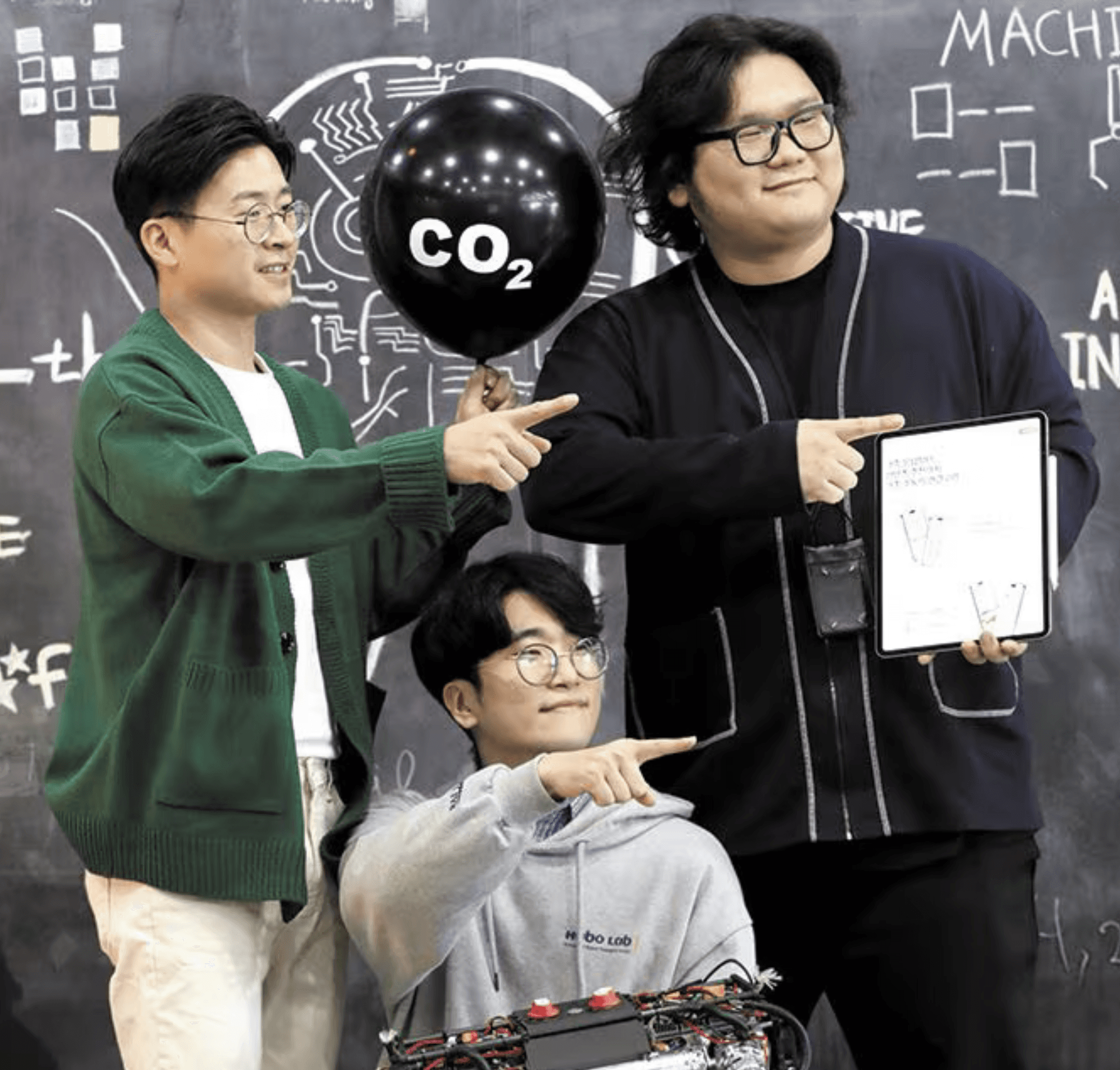
A four-legged robot that climbs walls, an omnidirectional wheeled robot, carbon capture technology using batteries, conductive garments, mental health apps for middle-aged individuals, and webtoon AI. These are business items from six entrepreneurs in their 30s studying at KAIST and POSTECH, often dubbed Korea's MIT and Caltech. These young founders are driven by ambitions to dominate the global market with innovative robotics and new material technology, aiming to solve critical issues like climate change and an aging population.
'Endless Challenges over High Salaries and Stable Jobs' - They have sacrificed high salaries and stable living. Instead, they've chosen to address societal challenges through technology. Six entrepreneurs from Korea's top tech universities, KAIST and POSTECH, are sprinting into 2024 with the resolve to change the world. Pictured on the left are Byung-soo Kim (from left), CEO of Greeners, Jun-ha Kim, CEO of Diden Robotics, and Ki-ung Cho, CEO of QoL LABS. On the right are Ji-sung Kim (from left), CEO of Cream, Gi-young Eom, CEO of Motomind, and Se-yoon Jang, CEO of Midas H & T. /Daejeon = Shin Hyun-jong reporter, Pohang = Kim Dong-hwan reporter
Korea's economy faced a tumultuous year last year. Ongoing global recessions, wars, and conflicts complicated international affairs, leading to the longest trade deficit since the foreign exchange crisis. The growth of Korea's key industries like semiconductors, electronic products, and petrochemicals also stagnated. While advanced nations, including the US, vie for AI technological power, Korea still lags in the AI race. Yet, this environment hasn't dimmed the fervor of young entrepreneurs.
Joon-ha Kim (29), CEO of Diden Robotics, Byung-soo Kim (38), CEO of Greeners, Ki-ung Cho (30), CEO of CEO of QoL LABS, Se-yoon Jang (31), CEO of Midas H & T, Gi-young Eom (23), CEO of Motomind, and Ji-sung Kim (23), CEO of Cream, are among the six who chose to pioneer changes instead of pursuing high salaries and stability. They all agreed, “We aim to be pioneers.” Youth entrepreneurship in Korea for those under 30 jumped from 140,000 (2018, according to Ministry of SMEs and Startups) to surpassing 180,000 in 2021, marking a 32% increase in three years. With relentless challengers like these, the engine of Korea's economy will keep running hot.
◇ Starting with World-Class Technology
Entrepreneurs from these top universities, with the country's most advanced tech researchers and students, are spearheading unique and innovative technologies on the global stage. Midas H & T is developing a malleable yet electrically conductive polymer material. This material allows clothes to conduct electricity, facilitating connections between various electronic devices, such as sensors. Simply wearing the clothing could monitor human movements, respiratory rate, and heart rate, and even generate heat. Se-yoon Jang, the CEO, stated, “We applied our technology to a golf swing balance system, achieving sales of 5 billion KRW last year and are acknowledged enough to engage in operational garment research with the US Air Force Research Laboratory.”
Diden Robotics' robot scales walls vertically by precisely controlling its magnetic four legs. Capable of walking on steel surfaces like Spider-Man, this magnet-footed robot can climb high altitudes swiftly, moving at 0.7 meters per second and overcoming small obstacles. CEO Jun-ha Kim said, “The robot can reach places like steel-framed buildings, oil tanks, bridges, and ships where human visual inspections are challenging, reducing a three-week task to just three days.”
Motomind's robot features omnidirectional wheels that can move easily in any direction, 360 degrees. Unlike existing delivery and serving robots which often struggle to find proper paths due to directional limitations, Motomind employs precise control over wheel movement and leverages AI to navigate complex urban and outdoor environments autonomously. CEO Gi-young Eom shared, “Our dream is to create a fully-automated level robot to reform the entire robotics industry.”
◇ Challenging Climate, Senior, AI Conundrums
These entrepreneurs take on challenges even major corporations would avoid. Greeners is developing a carbon capture module powered by battery technology. Using electrochemical technology principles, it captures only carbon dioxide during battery charging and releases it separately. It's like a 'carbon filter' using batteries. CEO Byung-soo Kim stated, “Because climate issues are an imperative that humanity must resolve, there is correspondingly strong market potential and opportunity.”
Quality of Life Research Institute is addressing 'mental health for middle-aged adults.' This company has developed a closed social media platform called 'AnswerLog,' where family members regularly participate in quizzes or surveys to foster conversations and understanding. CEO Ki-ung Cho said, “We are reintroducing family communication through social media services, incorporating elements that cater to mental health for middle-aged adults, aiming to solve a significant Korean issue.”
Cream has specialized AI for webtoons, a prominent Korean content industry. This AI mimics the artist's style, consistently rendering webtoon characters. CEO Ji-sung Kim commented, “While existing AIs yield different results every time an illustration is made, our AI can replicate an artist's style down to the strands of hair.” Despite ongoing debates over the value of AI-generated works, he added, “Ultimately, the reservation towards AI will dissipate within 1-2 years.”
◇ Entrepreneurship Chosen Over Secure Salaries and Employment
KAIST and POSTECH are the cradles of Korea's venture and startup ecosystem, having produced notable figures like the late Jung-Ju Kim (founder of Nexon) and Byung-Kyu Jang (founder of Krafton). By 2021, companies founded by KAIST alumni numbered 1,276, boasting a total revenue of 28 trillion won and a workforce of about 47,000. Both universities offer extensive entrepreneurial support to students, with POSTECH running 13 startup support programs, including an intensive three-month tech training business competition. Over the past three years, 107 teams have either established or prepared for a startup through the university.
However, what is more crucial than these support measures is the unwavering resolve of those who choose the path of challenge. Byeng-Soo Kim from Greeners explained, “Driven by a commitment to solving climate issues, I chose to study chemical engineering, left Hyundai’s hydrogen fuel cell business, and returned to university to start my own company.” Ki-Young Eum from Motomind stated, “I embarked on entrepreneurship with club friends from the Korean Science High School who shared my passion for robotics since high school. The joy of developing robots is beyond words,” while Sae-Yoon Jang from Midas H&T stated, “Business is not about selling products but delivering value. I want to change the world with engineering technology.”
Original article: Chosun Ilbohttps://www.chosun.com/economy/tech_it/2024/01/01/XCHH37GJCFET5IOGHF5Z77CNG4/