AI & Control

From learning algorithms to Sim-to-Real, we make robots walk on their own.

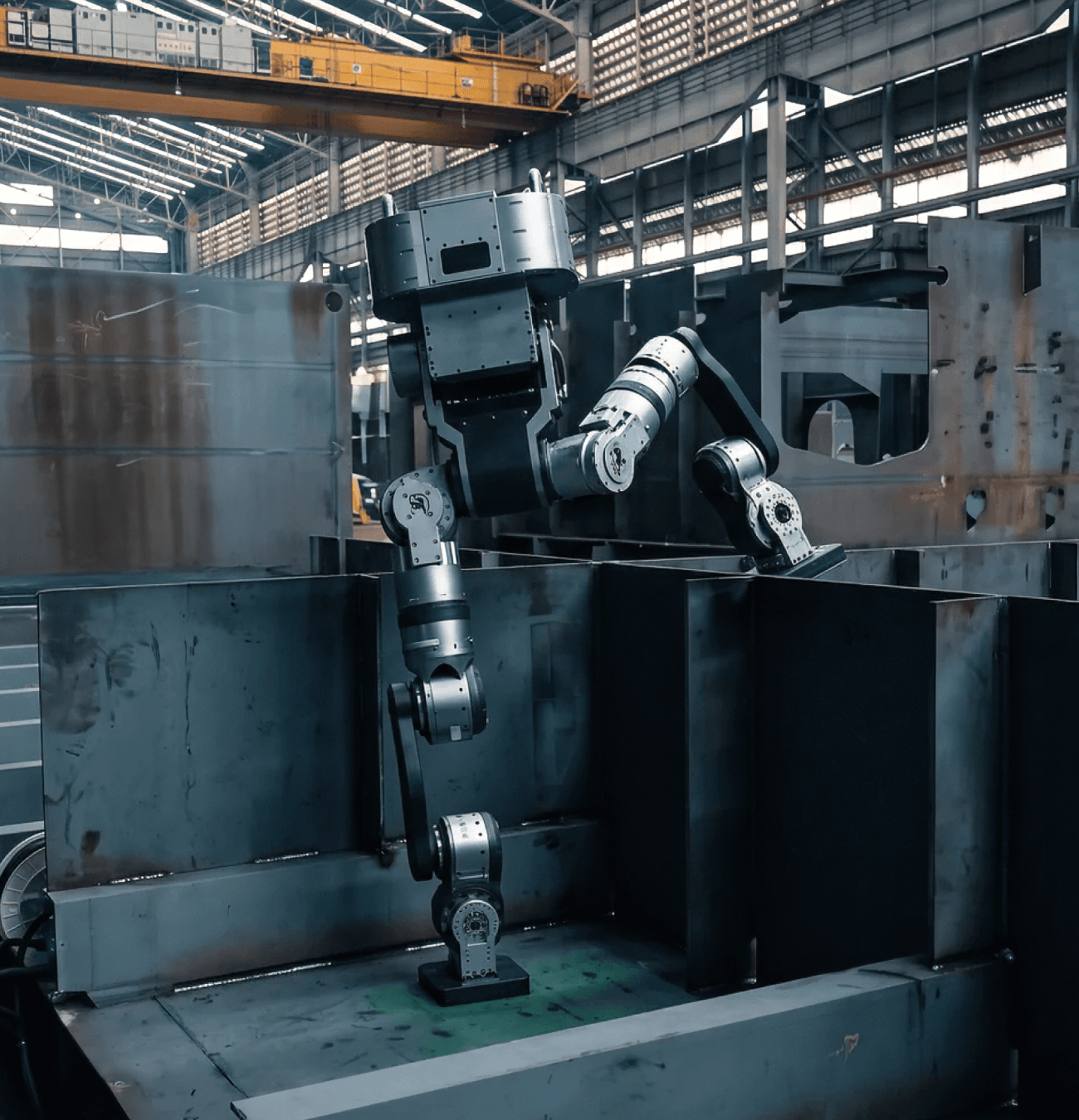
We train locomotion policies that hold steady in extreme environments, using learning algorithms that make full use of high-quality data and large-scale data collected across diverse conditions.

KEY FEATURE 01

Learning-Based Controller

We deliver stable controllers that are ready for immediate use under extreme conditions, built on an integrated pipeline from algorithm design to real-world transfer.

Controllers that survive extreme sites need the whole chain built right, so we build it all ourselves, from algorithm design to real-world deployment. In a high-fidelity physics simulator, we develop off-policy reinforcement learning that reuses model-predictive control (MPC) data, alongside motion-tracking and VLA methodologies.

01

Learning-Based Control Algorithm Design

We design learning methods that make the most of high-quality data, controlling robots efficiently with fewer trials.

To make effective use of high-quality data from Model Predictive Control (MPC), teleoperation, and other sources, we develop off-policy reinforcement learning, motion-tracking learning, and Vision-Language-Action models (VLA), achieving stable control even in extreme environments.

02

Reward Function Design

We design reward functions so the robot achieves its goal while moving naturally.

Optimizing for goal completion alone tends to produce unstable motion, so our reward functions define achievement and naturalness together, leading the robot to acquire high-quality behavior.

03

Sim-to-Real Transfer

Policies trained in simulation transfer directly to the real robot.

The Sim-to-Real gap can degrade performance, so we close it with domain randomization, keeping locomotion robust across varied terrain and external forces.

04

Training Simulator Optimization

We build virtual environments that closely mirror real industrial sites, helping robots learn quickly and accurately.

The special physical conditions of industrial sites such as shipyards are precisely replicated in a GPU-parallel simulator, and large-scale parallel training delivers high throughput and learning efficiency.

01

Learning-Based Control Algorithm Design

We design learning methods that make the most of high-quality data, controlling robots efficiently with fewer trials.

To make effective use of high-quality data from Model Predictive Control (MPC), teleoperation, and other sources, we develop off-policy reinforcement learning, motion-tracking learning, and Vision-Language-Action models (VLA), achieving stable control even in extreme environments.

02

Reward Function Design

We design reward functions so the robot achieves its goal while moving naturally.

Optimizing for goal completion alone tends to produce unstable motion, so our reward functions define achievement and naturalness together, leading the robot to acquire high-quality behavior.

03

Sim-to-Real Transfer

Policies trained in simulation transfer directly to the real robot.

The Sim-to-Real gap can degrade performance, so we close it with domain randomization, keeping locomotion robust across varied terrain and external forces.

04

Training Simulator Optimization

We build virtual environments that closely mirror real industrial sites, helping robots learn quickly and accurately.

The special physical conditions of industrial sites such as shipyards are precisely replicated in a GPU-parallel simulator, and large-scale parallel training delivers high throughput and learning efficiency.

AI & Control

AI Built to See, Decide, and Overcome

From simulation data generation to 3D occupancy prediction, CAD-based localization, and obstacle negotiation — we build the AI for autonomous mission execution.

KEY FEATURE 01

3D Mapping

Using AI, we build precise spatial maps that remove the uncertainty of blind spots.

From depth-camera data alone, the robot reconstructs its surroundings in real time as a 3D voxel map. The robot relies on this map to drive over and around obstacles. The neural network behind it is trained on auto-generated, auto-labeled simulation data that reflects sensor field of view, noise, and occlusion. A preprocessing pipeline identical to the real robot’s minimizes the Sim-to-Real gap, so it works in the field as is, with no on-site tuning.

01

Procedural Environment Generation

Virtual hull environments generated automatically by parameter-based algorithms

The complex terrain rules inside a hull are defined as parameters, and key variables such as structural dimensions and terrain geometry are randomized so that every generation automatically produces a different virtual environment. This maximizes the geometric diversity of training data and freely reproduces environments that are hard to capture in the field.

02

Virtual Sensor Data Generation

High-quality multimodal data collected automatically, reflecting real-world physical constraints

Virtual robots and multiple sensor types inside the simulator collect multimodal data automatically. Real-world constraints such as occlusion and sensor noise are replicated to minimize the Sim-to-Real gap, and automatic ground-truth labeling secures quality datasets at any scale with no manual work required.

03

Occupancy Prediction Beyond Line of Sight

A 3D spatial representation that covers even regions the sensors never observed

From observed point clouds and depth data, the system probabilistically infers the occupancy of occluded, unobserved regions and fills in areas beyond sensor reach with continuous voxels, enabling safe path planning that accounts even for obstacles in unseen areas.

04

Fine & Irregular Object Identification

Shape reconstruction and semantic classification of small, irregular obstacles

Each voxel’s semantic class is inferred alongside its occupancy, precisely distinguishing the objects in a space. Cables, small tools, pipes, and other irregular obstacles are reconstructed close to their true shape, going beyond what 3D bounding boxes could represent, so no collision hazard goes unnoticed.

01

Procedural Environment Generation

Virtual hull environments generated automatically by parameter-based algorithms

The complex terrain rules inside a hull are defined as parameters, and key variables such as structural dimensions and terrain geometry are randomized so that every generation automatically produces a different virtual environment. This maximizes the geometric diversity of training data and freely reproduces environments that are hard to capture in the field.

02

Virtual Sensor Data Generation

High-quality multimodal data collected automatically, reflecting real-world physical constraints

Virtual robots and multiple sensor types inside the simulator collect multimodal data automatically. Real-world constraints such as occlusion and sensor noise are replicated to minimize the Sim-to-Real gap, and automatic ground-truth labeling secures quality datasets at any scale with no manual work required.

03

Occupancy Prediction Beyond Line of Sight

A 3D spatial representation that covers even regions the sensors never observed

From observed point clouds and depth data, the system probabilistically infers the occupancy of occluded, unobserved regions and fills in areas beyond sensor reach with continuous voxels, enabling safe path planning that accounts even for obstacles in unseen areas.

04

Fine & Irregular Object Identification

Shape reconstruction and semantic classification of small, irregular obstacles

Each voxel’s semantic class is inferred alongside its occupancy, precisely distinguishing the objects in a space. Cables, small tools, pipes, and other irregular obstacles are reconstructed close to their true shape, going beyond what 3D bounding boxes could represent, so no collision hazard goes unnoticed.

KEY FEATURE 02

CAD-Based Localization

Using pre-prepared CAD data as its map, the robot finds its own position.

Even inside ship blocks where GPS cannot reach, the robot determines its own position and orientation. 3D spatial data collected in real time is automatically matched against the CAD model of the work environment to estimate absolute position, and our proprietary algorithms maintain precise registration even on noise-heavy sites.

01

Environment Perception

Sensor fusion reconstructs the surroundings in 3D, providing the foundation for localization

Multi-depth-camera data is converted into real-time 3D point clouds, and frame-to-frame registration computes the robot’s relative displacement, accumulated in a unified coordinate system. Surface normals and confidence values are also generated per point, securing input quality and computational efficiency for the subsequent CAD registration.

02

Intelligent Automatic Initial-Pose Search

A reliable initial pose, established through candidate search across the CAD map and registration-error screening

At startup, a multi-start technique searches broad candidate regions of the CAD simultaneously, and top candidates are screened by their registration error against the live scan. The system filters out duplicates from similar regions and establishes the reference coordinates. The accuracy and stability of all subsequent tracking depend on this step.

03

Real-Time Position Tracking

The robot’s precise position, estimated in real time with CAD data as the map

Once the initial pose is fixed, every frame’s 3D point cloud is registered against the CAD model in real time to track the robot. Point-to-Plane ICP registration uses the previous frame’s pose as its initial value and updates the full 6-DOF state.

04

Handling Rapid Pose Changes

Stable tracking maintained even through abrupt changes in robot pose

To resolve the data uncertainty of rough-terrain driving and rapid maneuvers, frame-to-frame registration and CAD matching run every frame. Normal-vector consistency checks and confidence weighting automatically reject transient noise and false detections, preserving precise localization even in extreme situations.

01

Environment Perception

Sensor fusion reconstructs the surroundings in 3D, providing the foundation for localization

Multi-depth-camera data is converted into real-time 3D point clouds, and frame-to-frame registration computes the robot’s relative displacement, accumulated in a unified coordinate system. Surface normals and confidence values are also generated per point, securing input quality and computational efficiency for the subsequent CAD registration.

02

Intelligent Automatic Initial-Pose Search

A reliable initial pose, established through candidate search across the CAD map and registration-error screening

At startup, a multi-start technique searches broad candidate regions of the CAD simultaneously, and top candidates are screened by their registration error against the live scan. The system filters out duplicates from similar regions and establishes the reference coordinates. The accuracy and stability of all subsequent tracking depend on this step.

03

Real-Time Position Tracking

The robot’s precise position, estimated in real time with CAD data as the map

Once the initial pose is fixed, every frame’s 3D point cloud is registered against the CAD model in real time to track the robot. Point-to-Plane ICP registration uses the previous frame’s pose as its initial value and updates the full 6-DOF state.

04

Handling Rapid Pose Changes

Stable tracking maintained even through abrupt changes in robot pose

To resolve the data uncertainty of rough-terrain driving and rapid maneuvers, frame-to-frame registration and CAD matching run every frame. Normal-vector consistency checks and confidence weighting automatically reject transient noise and false detections, preserving precise localization even in extreme situations.

KEY FEATURE 03

Autonomous Locomotion Framework for Industrial Structures

Self-developed high-speed obstacle avoidance · waypoint-based autonomous navigation · user-defined scenarios · automatic training-data assetization

Even among complex industrial structures, the robot finds the optimal path in real time. Experience-driven high-speed obstacle avoidance and vision-based waypoint navigation are joined by Task Authoring, which lets users design waypoints to fit their site. Demanding motions generated along the way are automatically turned into assets, accumulating as AI training data.

01

Sampling-Based High-Speed Obstacle Avoidance

A path library grafted onto sampling algorithms raises computational efficiency and accelerates obstacle avoidance.

Experience-based search applied to 9D Bi-RRT reuses previous paths as the initial tree. Skipping needless recomputation maximizes search efficiency, generating precise, latency-free locomotion even in highly constrained environments.

02

Vision-Based Waypoint Navigation

CAD-based absolute positioning combined with vision achieves precise waypoint-arrival navigation.

Vision-based state estimation corrects position error in real time. Variable deceleration in the tracking algorithm lets the robot settle onto its target accurately and smoothly, with no overshoot even from high speed.

03

User-Centered Scenario Composition

A user-friendly authoring system manages multiple tasks as one unified scenario.

It provides an environment for intuitively combining and designing heterogeneous tasks such as CAD-based navigation, welding, and picking. Parameter optimization builds custom scenarios, and fully automated repetition gives the system the versatility to handle special-purpose work with ease.

04

Automatic Training-Data Assetization

An advanced data-assetization system accumulates all behavior data, real and virtual, on our servers.

Everything from low-level sensors to control logs is collected in one stream, and 3D reconstruction creates a virtual replica of the site. The result is a data flywheel that mass-produces simulation-based vision data and continuously advances our AI models.

01

Sampling-Based High-Speed Obstacle Avoidance

A path library grafted onto sampling algorithms raises computational efficiency and accelerates obstacle avoidance.

Experience-based search applied to 9D Bi-RRT reuses previous paths as the initial tree. Skipping needless recomputation maximizes search efficiency, generating precise, latency-free locomotion even in highly constrained environments.

02

Vision-Based Waypoint Navigation

CAD-based absolute positioning combined with vision achieves precise waypoint-arrival navigation.

Vision-based state estimation corrects position error in real time. Variable deceleration in the tracking algorithm lets the robot settle onto its target accurately and smoothly, with no overshoot even from high speed.

03

User-Centered Scenario Composition

A user-friendly authoring system manages multiple tasks as one unified scenario.

It provides an environment for intuitively combining and designing heterogeneous tasks such as CAD-based navigation, welding, and picking. Parameter optimization builds custom scenarios, and fully automated repetition gives the system the versatility to handle special-purpose work with ease.

04

Automatic Training-Data Assetization

An advanced data-assetization system accumulates all behavior data, real and virtual, on our servers.

Everything from low-level sensors to control logs is collected in one stream, and 3D reconstruction creates a virtual replica of the site. The result is a data flywheel that mass-produces simulation-based vision data and continuously advances our AI models.

See how our robots
bring these capabilities to life

See how our robots
bring these
capabilities to life