DIDEN Robotics Showcases Physical AI Technology at MARS Conference 2026 Hosted by Jeff Bezos
Physical AI company DIDEN Robotics was the only Korean company invited to MARS 2026, Jeff Bezos' invitation-only technology conference. The KAIST-founded team demonstrated DIDEN Spider's autonomous hole-crossing on steel structures — showcasing reinforcement learning-based locomotion control, vision AI, and field-proven industrial robotics.
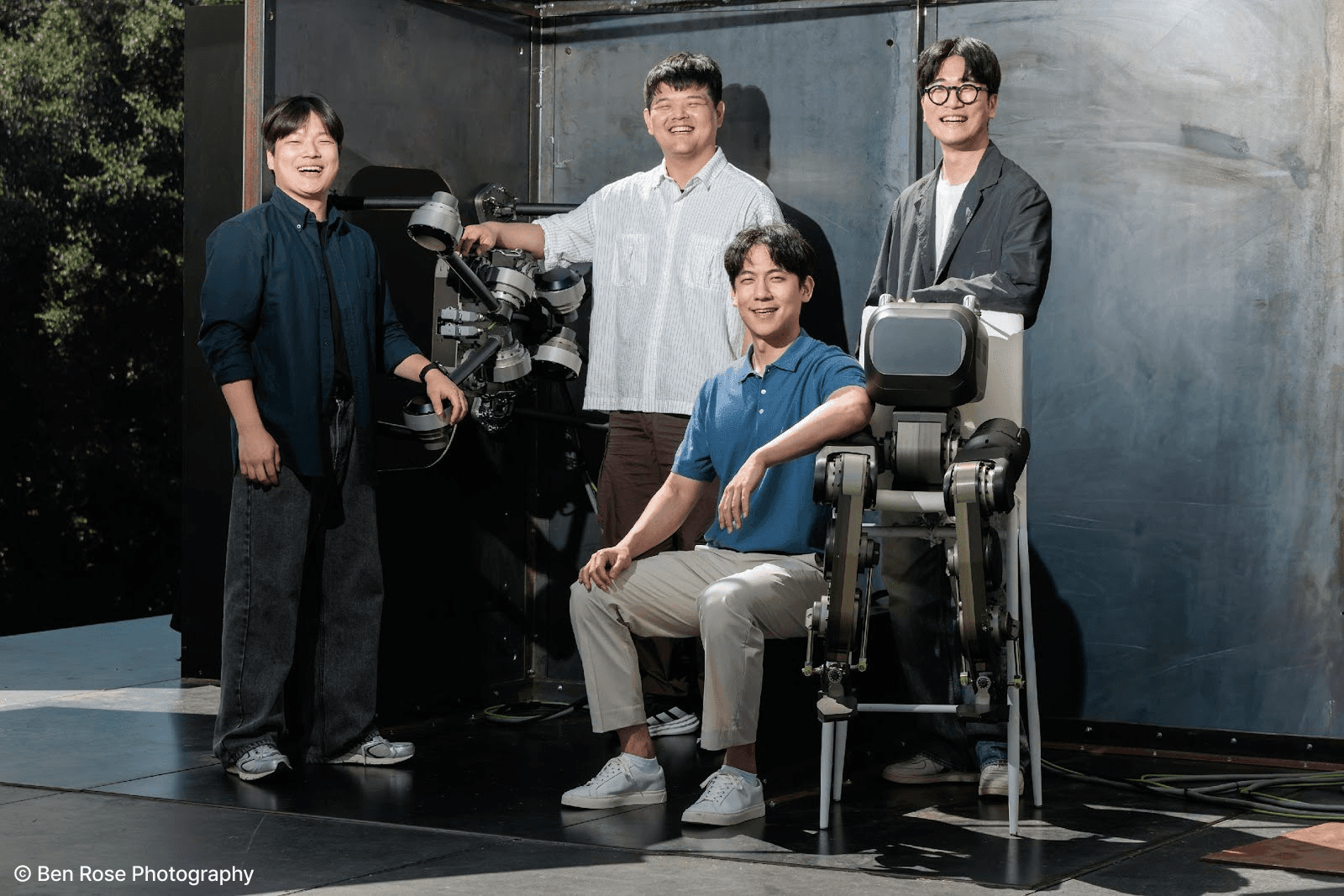
A Robot on a Steel Wall
Picture a four-legged robot on a vertical steel structure. Its feet lock onto the surface, and it moves forward, reading the terrain as it goes. It reaches a hole in the metal plate, pauses, recalculates, and steps across — one leg at a time, never losing grip. The crowd leans in.
This was MARS Conference 2026, a global invitation-only technology conference. The robot was built by DIDEN Robotics, a Physical AI company from South Korea — the only Korean company at this year's event, and only the second Korean company ever to participate in MARS. A KAIST research team was also invited to the conference.
What Is MARS?
MARS stands for Machine learning, Automation, Robotics, and Space. Hosted since 2016 by Jeff Bezos, the founder of Amazon and Blue Origin, it is one of the most exclusive technology gatherings in the world. Roughly 200 scientists, founders, and industry leaders are invited each year to present their work, exchange ideas, and witness demonstrations of emerging technologies.
The event is invitation-only. There is no registration page, no ticket price. Researchers and entrepreneurs working at the frontier of machine learning, robotics, and space gather in a small, closed setting for technology demonstrations and in-depth conversation. For a robotics company, being invited to demo at MARS is a recognition that the technology is relevant at the global scale.
Twenty Teams, One Question
The demo zone at MARS Conference 2026 featured roughly twenty teams. The range was broad: from major robotics companies to university research groups including KAIST, all sharing the same exhibition space. DIDEN Robotics showcased both its quadruped robot DIDEN Spider and its bipedal industrial platform DIDEN Walker, with Spider as the focus of the live demonstration.
Despite the diversity, a central question kept surfacing in conversation after conversation: “How well does this work in the real world?”
This is not an abstract question for industrial robotics. Robots that perform flawlessly in a lab often fail within minutes on an actual job site. At oil refineries in the Middle East, where temperatures exceed 50°C, some robots shut down after just thirty minutes of operation. Dust, vibration, uneven surfaces, and extreme heat create an environment where theoretical specifications mean very little.
The companies that had answers to this question attracted the most attention.
DIDEN Spider: Crossing the Gap
DIDEN Robotics demonstrated its quadruped industrial robot, DIDEN Spider, performing a hole-crossing maneuver on a steel structure. The robot walked along a vertical metal surface, approached a gap in the structure, and traversed it while maintaining stable contact with the surface.
Why does crossing a hole matter? Because real industrial environments are not smooth, continuous surfaces. Shipyards, power plants, and offshore structures are filled with reinforcement ribs, welding seams, pipe penetrations, and access holes. A robot that can only walk on flat steel is a lab demonstration. A robot that can navigate discontinuities is a tool for the real world.
What makes this possible is not any single component, but the integration of multiple AI and control systems working together. Reinforcement learning-based locomotion control determines the timing of each foot’s attachment and detachment in real time. Vision AI recognizes the geometry of the structure ahead. State estimation algorithms maintain the robot’s posture and balance on irregular surfaces. The hole-crossing maneuver is the result of these systems operating in concert — a demonstration of Physical AI in practice.
DIDEN Robotics has been building toward this capability through sustained work in actual shipyards. The company currently collaborates with three of South Korea’s largest shipbuilders simultaneously, and has already performed welding operations in live production processes — not just demonstrations, but actual manufacturing work on real vessels.
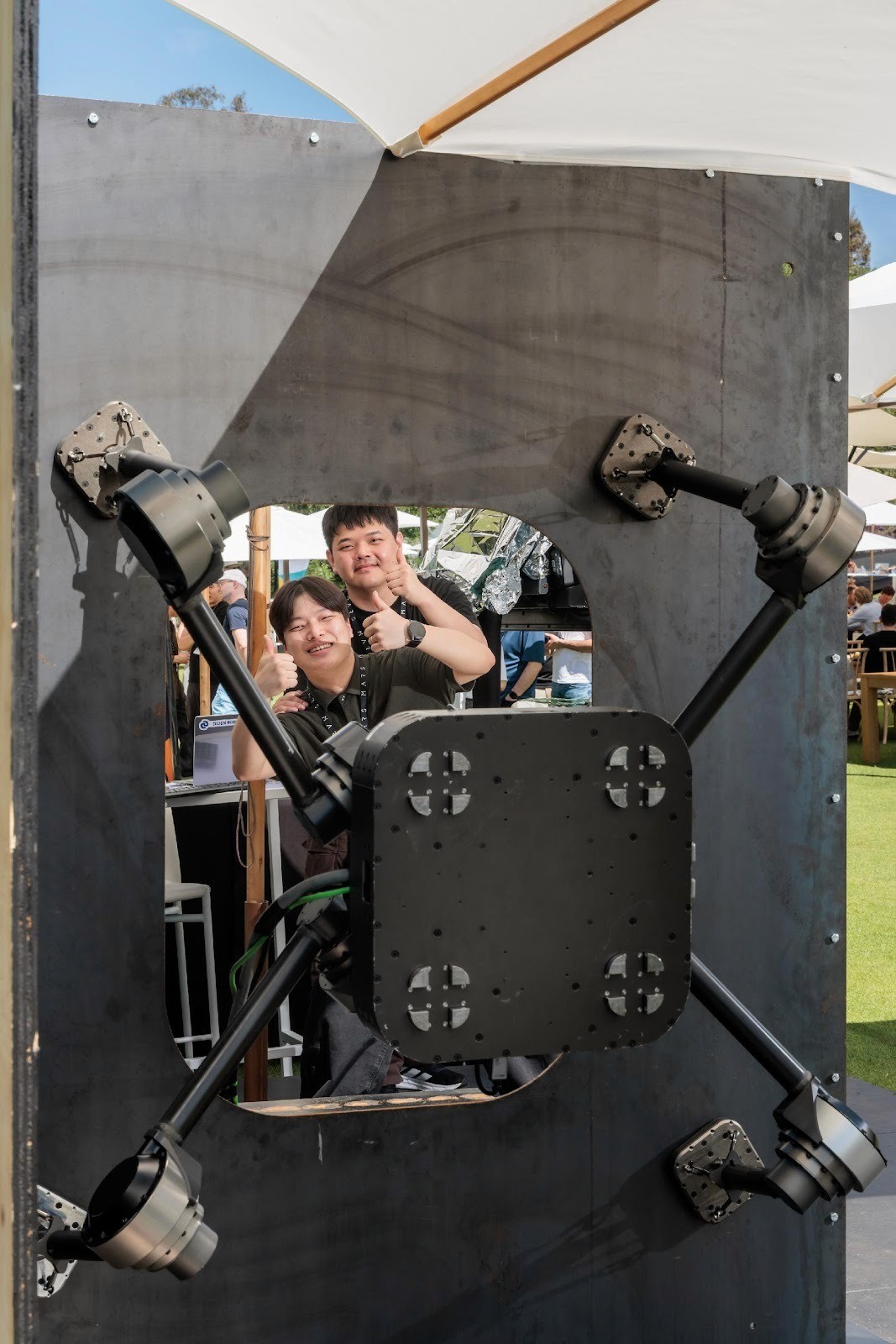
DIDEN Spider demonstrating hole-crossing on a vertical steel structure at MARS Conference 2026 ⒸBen Rose Photography
Built from Scratch, Proven on Site
DIDEN Robotics develops its technology end-to-end. Actuators, mechanical structures, and electronics are all designed and manufactured in-house. On the software side, the team has built its own stack from the ground up: reinforcement learning-based locomotion that teaches robots to walk through trial and error, vision AI that reads the environment in real time, state estimation that tracks the robot’s posture and balance, and simulation environments where thousands of scenarios are tested before a single step is taken on a real job site.
This vertically integrated approach — hardware through AI — is what defines DIDEN Robotics as a Physical AI company. It is also what enables rapid iteration. When something goes wrong on a job site, the team can trace the issue from the AI layer down to the hardware component, fix it, and redeploy. This cycle of field testing, debugging, and improvement has been running continuously since the company’s founding.
The team’s roots run deep in robotics research. Founded in March 2024 by four members of the KAIST Humanoid Robot Research Center, DIDEN Robotics carries the legacy of one of Asia’s most respected robotics programs. CEO Joonha Kim holds a Ph.D. in Mechanical Engineering from KAIST and has published in IEEE T-RO, RA-L, and IJRR, among the field’s most rigorous journals.
The next frontier for the team is humanoid robotics. The reinforcement learning-based locomotion control, state estimation, and simulation-driven development behind DIDEN Spider are now being applied to DIDEN Walker, a bipedal industrial platform. Walker’s lower body was developed in three months, from hardware design to control, and achieved stable walking on its very first test.
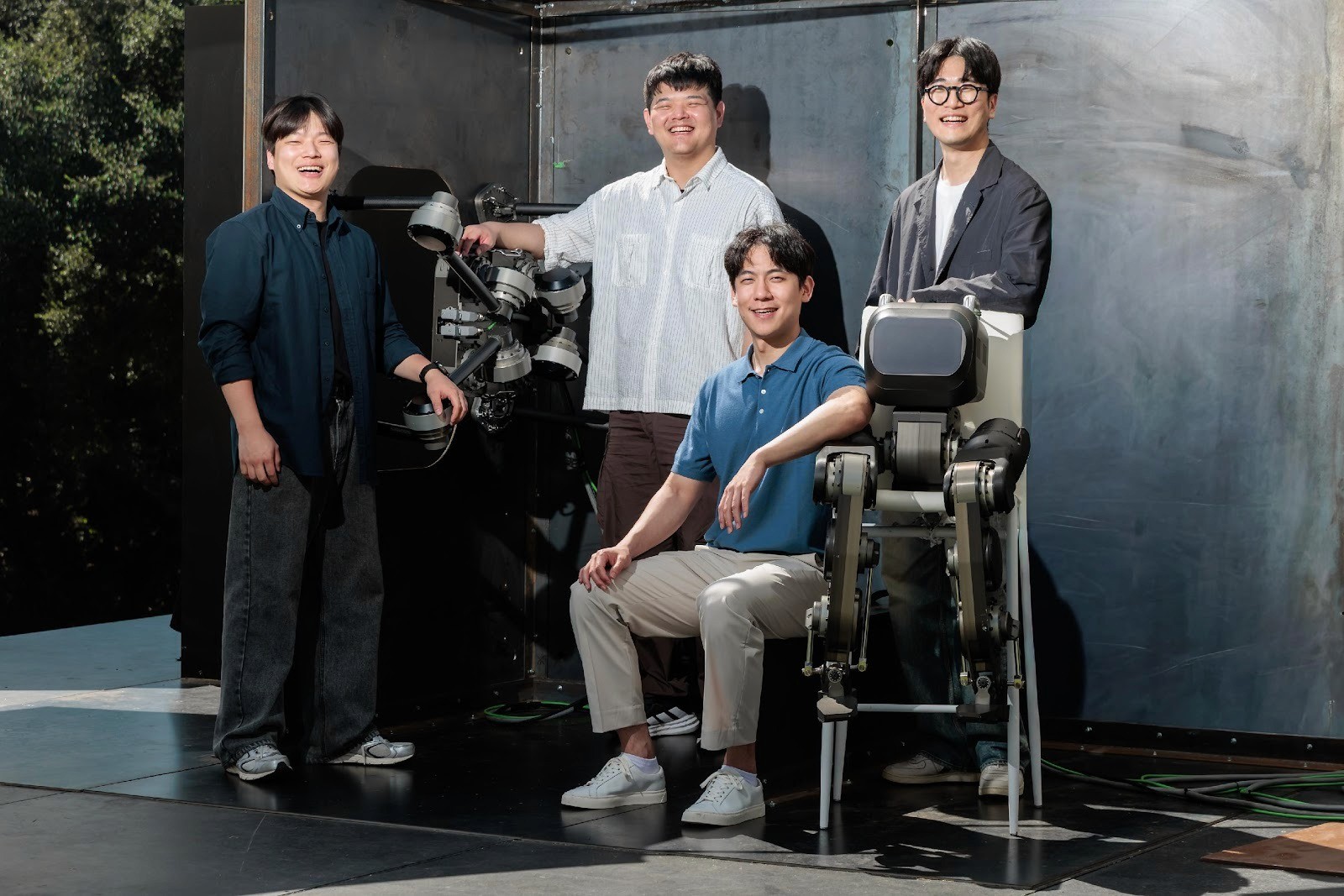
DIDEN Robotics team at MARS Conference 2026 with DIDEN Spider and DIDEN Walker ⒸBen Rose Photography
What Comes Next
MARS Conference 2026 was a milestone, but the trajectory points forward. The technology that started in shipyards is being adapted for plant inspection, infrastructure maintenance, and construction. From four legs to two, from one industry to many. MARS was one scene in that journey.
South Korea
©Copyright DIDEN Robotics. All Right Reserved
Terms of Service
|
Privacy Policy
|
Legal Notice
|
Prohibition of Unauthorized Email Collection
Diden Robotics Co., Ltd.
|
Representative: Junny(Joon-Ha) Kim
|
Contact: diden@didenrobotics.com / Phone: 02-6959-0642 / Fax: 02-6959-0643
|
49 Achasan-ro 17-gil, Seongdong-gu, Seoul, Rooms 401, 402, 409, 410 (04799)
|
Business Registration Number: 867-87-03056
DIDEN ROBOTICS