Why a Quadruped, a Biped, and a Humanoid All Walk the Same Way: Co-Designing Actuators and Learning
DIDEN Robotics' quadrupedal robot, bipedal platform, and humanoid all learn to walk the same way. All three are built on the same in-house actuator module and run on a single learning pipeline. What makes this possible is co-designing hardware and learning: measuring the actuator's physical characteristics (backlash, friction, the current-torque relationship, and so on) quantitatively, and folding those numbers back into training. A design note on the drive platform from DIDEN Robotics, the Physical AI company built for industrial environments.
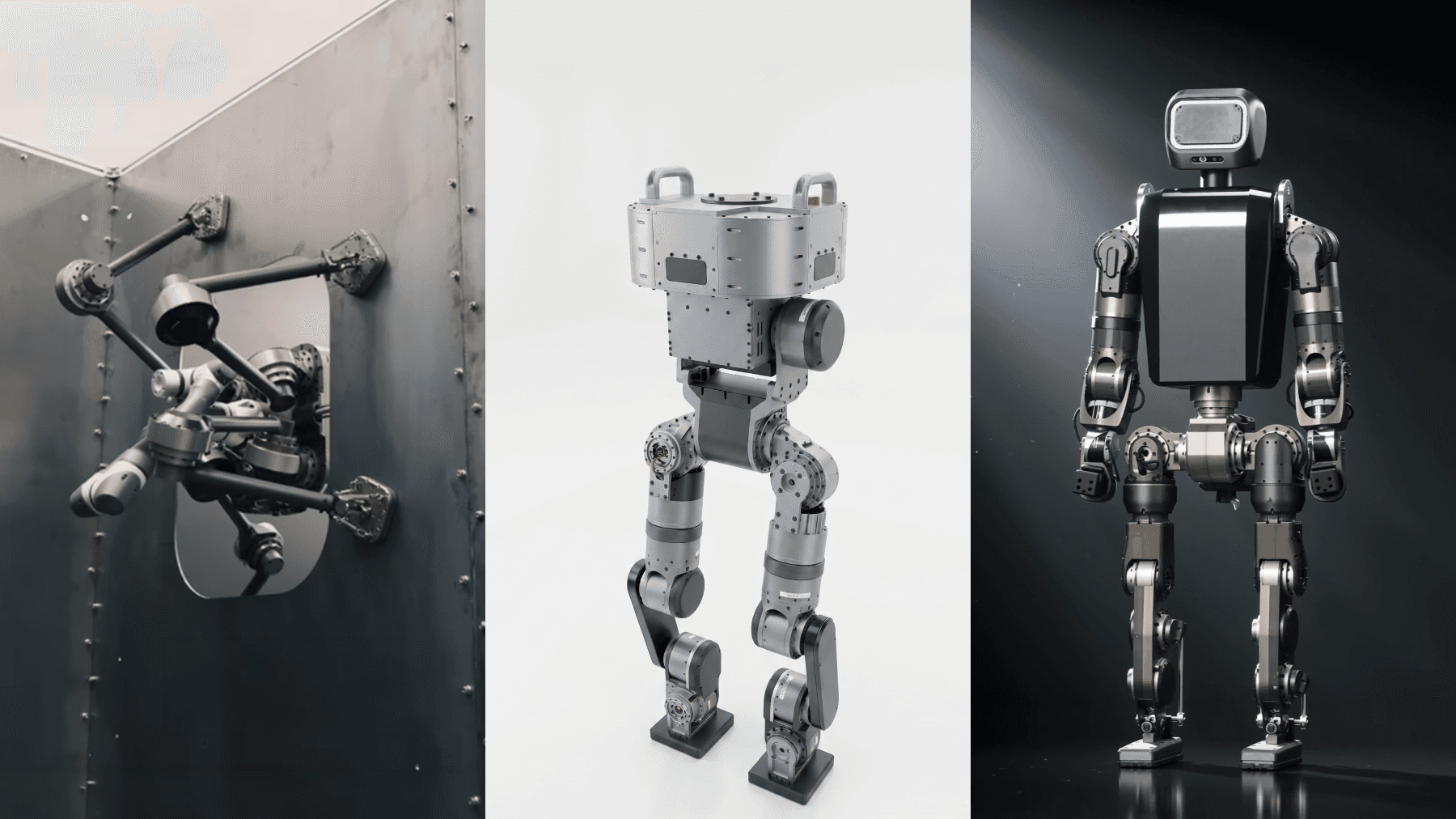
DIDEN Robotics' quadrupedal robot, bipedal platform, and humanoid learn to walk the same way. The three differ in form, but all of them are built on the same in-house actuator module and pick up their motion on top of a single learning pipeline.
This is possible because DIDEN Robotics did not finish the hardware first and attach the learning later. Actuator design and robot learning were treated as one problem from the beginning. Because hardware and learning were designed together, one platform and one pipeline can drive several different robot bodies.
This note covers how an in-house actuator makes learning possible and how a single drive stack designed that way carries over to several different robot bodies.
The Distance Between Simulation and the Floor
Industrial walking robots mostly learn to walk inside simulation first. They run thousands to tens of thousands of virtual trials to find the right motions, then that policy is applied to the real machine. Learning in simulation and carrying the result into the real world is now close to standard practice for industrial quadrupeds and bipeds.
The trouble appears when that policy meets the real robot. A robot that walked cleanly in simulation often becomes unsteady on the floor because the simulated robot and the real robot differ in subtle ways. This difference between simulation and the real robot is called the sim-to-real gap, and narrowing it is a central challenge in controlling a real machine.
There are two broad ways to close that gap. One is to refine the algorithm further. The other is to make the robot inside the simulation resemble the real one more closely. DIDEN Robotics focused on the second, and the starting point sat at the deepest layer of the robot: the actuator.
Where the Gap Is Decided
Differences between simulation and reality arise in many places, but the ones that actually unsettle a learned locomotion policy mostly originate in the actuators that move the joints. Three properties in particular are the ones learning reacts to most sharply.
Backlash: Play Between Gear Teeth
Backlash is the small amount of play between meshing gear teeth. A simulation assumes the joint moves immediately to the commanded angle, but a real gear carries play, so a small discrepancy opens up between the command and the actual motion. That discrepancy affects foot placement and contact timing during walking, and it can be the reason a motion learned in simulation comes out differently on the real robot.
Friction and Back-Drivability: How the Joint Responds
Back-drivability is the property that lets a joint yield smoothly when an external force pushes on it. A learning-based locomotion policy builds its motions on the assumption that the joint responds pliantly to the shock of a foot landing or to an unexpected external load. An actuator with high friction and low back-drivability responds more stiffly and cannot let force pass through the way the simulation expected.
Torque Response and Structural Deflection: Values That Differ Unit by Unit
Even the same motor model produces torque a little differently from unit to unit, and an aluminum structural member deflects slightly under heavy load. Neither can be read off a spec sheet's theoretical values. The two are handled differently, though. Torque response is measured unit by unit and reflected in simulation, while structural deflection is addressed less by feeding it into simulation and more by designing for higher stiffness.
Many companies choose to buy commercial actuators and assemble them. But assembled that way, these properties are only known as the spec sheet's ideal figures. Build a simulation without the real, unit-specific values, and the policy trained on top of it ends up walking on physics it does not actually know. The sim-to-real gap opens right at that point.
Designing Hardware and Learning Together
To control a property, you first have to be able to measure it, and to measure it, you have to be able to build the actuator yourself. That is one of the reasons DIDEN Robotics designs and manufactures its actuators in-house.
DIDEN Robotics' in-house actuator is an integrated hollow-shaft unit that combines motor, gears, frame, motor driver, and wiring into a single module. Rather than sourcing parts externally and assembling them, the team manufactures the core elements from the start, assembles them, and runs the quality testing itself.
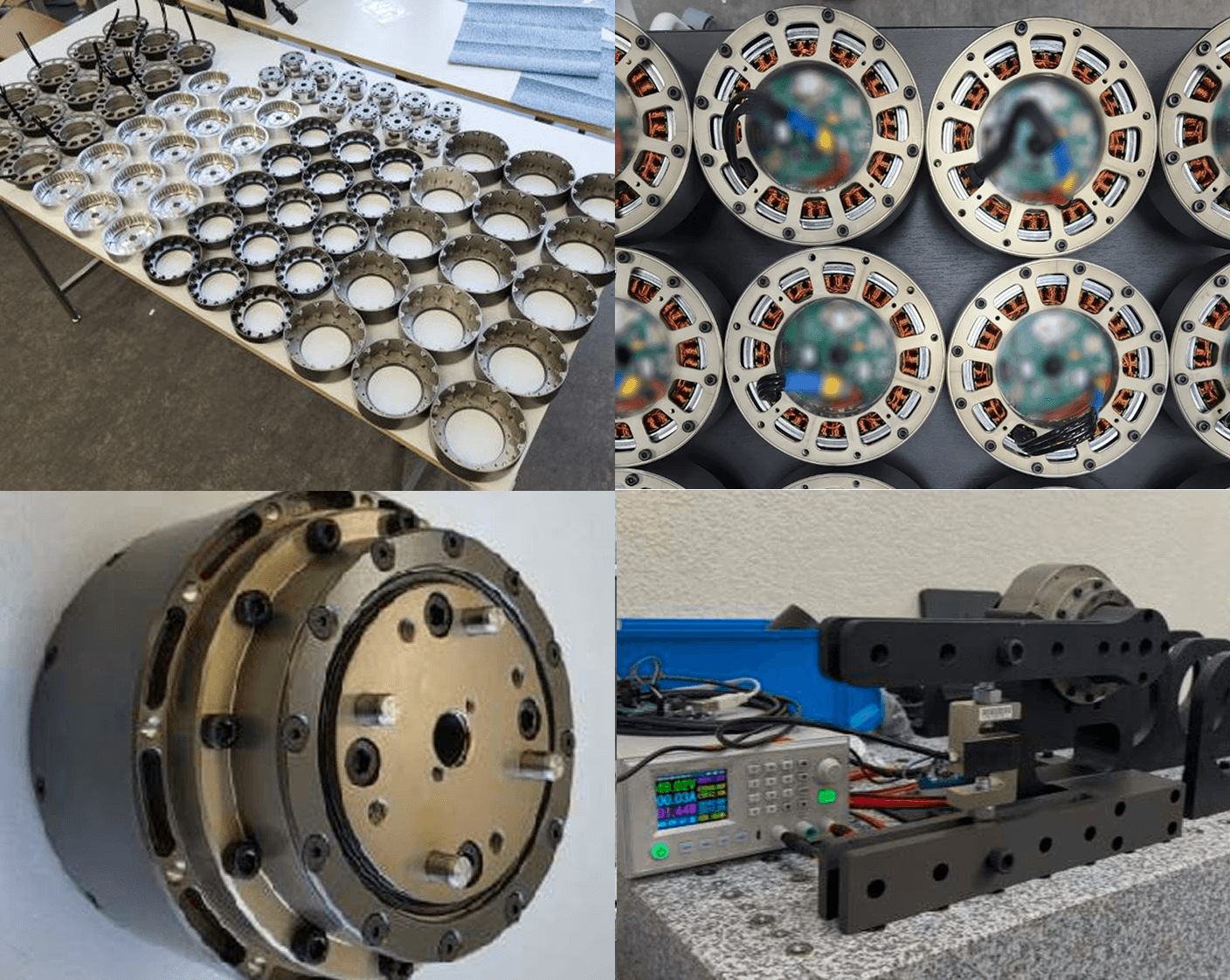
A hollow-shaft actuator designed and built in-house by DIDEN Robotics. The properties learning needs are secured from the design stage.
Because the team builds the actuator, it can measure the real properties of each unit: how much backlash there is, what the friction and back-drivability look like, how the torque response and deflection behave. What it holds in hand is not the spec sheet's theoretical value but the actual value produced by the actuator in front of it. With those measurements, the simulation can be tuned close to reality, and a policy trained on top of it stays stable when it moves onto the real robot.
This is what DIDEN Robotics means by co-designing hardware and learning. The actuator is not treated as a component unrelated to learning, with control bolted on afterward. The team first identifies which properties the learning needs, then designs the actuator in the direction that preserves them.
Preserving the Properties Learning Needs
Which drive type you choose looks like a question far removed from learning, but it is tied directly to whether the learning succeeds. Depending on the drive type, the properties learning depends on either survive or disappear. That judgment is part of why DIDEN Robotics started its actuator design from a rotary motor combined with a planetary gear.
Another approach is also widely used in the field: the linear actuator. It is a different route from the rotary drive DIDEN Robotics chose, and several players in the global humanoid market have adopted it, particularly for lower-body joints. A linear actuator converts a rotary motor's rotation into linear motion through a ball screw or a roller screw, moving the joint in a manner similar to human muscle. It makes high reduction ratios easy to achieve in tight spaces, gives an intuitive load path, and removes the need to place the motor on the joint axis.
Seen from the perspective of robot actuator design, though, the weaknesses of a ball-screw structure also become visible. The moment arm changes with joint angle, the range of motion can be limited depending on the linkage, and a higher part count drives manufacturing cost up quickly. On top of that, for a robot moving across steel surfaces, the structure is comparatively vulnerable to the impact of a magnetic foot landing. In short, a linear actuator increases dependence on off-the-shelf parts, and building one in-house at this stage carries considerable difficulty and cost.
A rotary motor paired with a planetary gear strikes a different balance. A planetary gear allows a little backlash in exchange for withstanding heavy impact, and it also makes relatively high back-drivability achievable. The legs and lower-body joints, which absorb the impact of a magnet landing on a surface every day, need that robustness first, and on top of it the yielding characteristic a learned policy relies on can also be preserved.
Both approaches do coexist in the field, so neither can be declared the single correct answer. Even so, DIDEN Robotics chose the combination of a rotary motor, a planetary gear, and an in-house hollow-shaft module because that combination satisfies industrial-site conditions first while also preserving the properties learning needs.
Folding Measurements Into Simulation
Once the design has preserved the necessary properties and those properties have been measured on the manufactured actuator, the final step is to fold the measurements into simulation.
DIDEN Robotics quantitatively measures backlash, friction and back-drivability, and torque response on its in-house actuators, and reflects them in simulation. Because values differ slightly from unit to unit, what goes into the simulation is not a single ideal value but the range actually observed, and the policy is trained to operate stably across that range. Since the simulation runs on the real behavior of the actuator rather than on theoretical values, a locomotion policy trained there also works stably on the real robot.
DIDEN Robotics' co-design forms a single loop. First, identify the properties learning needs and design the actuator to preserve them. Then measure the real properties on the manufactured actuator. Feed those values into simulation to train the policy, and validate the trained policy on the real robot again. Through this process, the actuator and the learning are not separate things but links in one chain.
Robots That Learn to Walk the Same Way
That loop becomes a single learning pipeline. DIDEN Robotics' learning and control pipeline uses reinforcement learning together with model-based control to produce locomotion for legged robots. The robot learns its walking policy in a simulation grounded in the actuator's real behavior, and that policy is then carried onto the real machine.
Three Things the Robot Does Not Know
Learning-based control is a way of letting a robot find, on its own, motions that are hard to write down rule by rule. Yet the robot starts out without fully knowing the world it is placed in. It begins training without knowing exactly what counts as good walking (the reward), how the real environment will respond (the dynamics), or what state it is currently in (the state).
Among these, not knowing the dynamics connects directly to the actuator properties discussed earlier. To close that gap, the learning team measures real values and reflects them in simulation: the friction coefficient of the steel surface, the magnetic foot's force and how it changes, and the play in the joint actuators, or backlash. Measuring an actuator's properties and reflecting them in simulation is therefore not only the hardware team's job; it is also part of how the learning team designs for transfer to the real robot.
Not knowing the reward and the state is addressed differently. What counts as good walking is refined little by little through field tests and human judgment, and motions that are hard to master all at once are trained by starting easy and raising the difficulty step by step.

Simulations of the quadrupedal robot's Adaptive Gait Period (left) and Curriculum Learning (right).
Learning in Two Stages
Even as the simulation comes closer to reality, pure reinforcement learning alone ran into limits on the hardest terrain. For motions like passing through a narrow opening or stepping over a tall stiffener, it is extremely difficult to express in a reward what doing it well even means.
So DIDEN Robotics splits learning into two stages.
First, model-based control plans a physically feasible motion that clears the obstacle. The experience gathered that way is then reused in reinforcement learning: the robot is trained so that the more closely it tracks the motion produced by model-based control, the higher the reward it earns. This is called motion-tracking reinforcement learning.
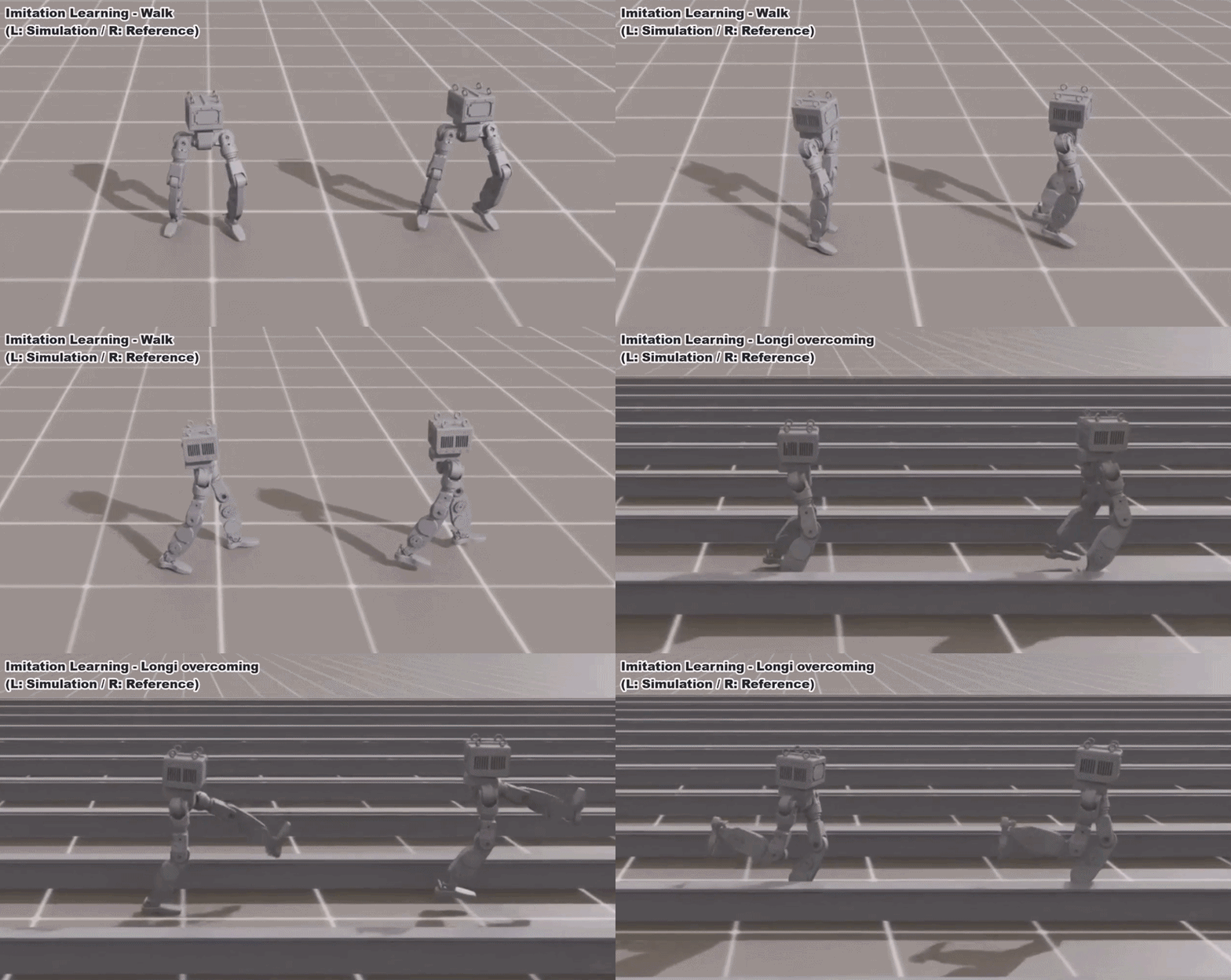
In simulation, the bipedal platform (left) walks by following a reference motion prepared in advance (right). The more closely it follows the motion built by model-based control, the higher the reward it receives.
Disturbances and other varied conditions are also injected into this training environment, so that the robot behaves more robustly in real situations than model-based control alone would. In this way, model-based planning and reinforcement learning are bound into one pipeline instead of competing with each other. The approach has been applied to the quadrupedal robot and validated in practice.

Even under strong external force, the quadrupedal robot steps over a stiffener. When disturbances are injected into the training environment, the robot keeps its footing against unexpected forces in the field.
Here, the co-design proves its worth again, because the pipeline is set up to run on the measured properties of the in-house actuator rather than on theoretical values. As a result, training a robot of a new shape does not require characterizing the hardware from scratch. Once the properties of the shared actuator module are secured on the quadruped, those values carry straight over into the simulations of the biped and the humanoid. What changes is the shape of the body and the joint layout; the actuator moving those joints is the same module. In short, it becomes a structure where the body is swapped on top of one core technology stack.
It is worth separating what is shared from what changes with each body. What the different forms share is the actuator model and the learning infrastructure, meaning the simulation environment and the reward structure. What changes with the form, such as gait and balance control, is set anew for each robot. Put simply, the same muscle and the same learning method are shared, while how to walk is learned to fit each body.
What Sharing One Pipeline Delivers
The shared drive module does not stop at the legs. For the humanoid as well, every actuator except the hands is developed in-house and built on the same design principles. When several robot forms share the same actuator module and the same learning pipeline this way, three advantages follow.
1. Development Speed
An actuator validated on one platform is applied directly to the next, and the learning pipeline tuned to that actuator travels with it. DIDEN Robotics took its bipedal platform from in-house hardware to two-legged walking in roughly three months, and that came from reusing the actuator already proven on the quadruped along with the learning and control experience built on top of it. With no need to prepare the actuator and the simulation environment from scratch, development of a new robot can put its weight on learning the motions that suit its form.
2. Manufacturing Efficiency
When several robot forms share the same core component, sourcing, production, and quality control run on a single line. That costs less than building three kinds of robots from separate parts. Given that a single robot contains more than twelve actuators, sharing components carries real commercial weight.
3. Sim-to-Real Alignment
The co-design loop described earlier does not apply to one body alone; it works across the several forms that use the same module. Once the properties of a single actuator are secured quantitatively, those values can be used across the simulations of the quadruped, the biped, and the humanoid alike. Each time a new body is added, there is no need to characterize the physics and set up the simulation all over again.
What matters is that a real industrial site needs all of these forms, depending on the situation. A quadruped is strong at carrying heavy loads, while a biped is strong at using passages, ladders, and stairs built for people, exactly as they are. So the quadrupedal robot moves freely across steel surfaces on magnetic feet and carries heavy work equipment, while the bipedal platform and the humanoid pass through narrow openings and work where a person would stand. The same actuator module and the same learning pipeline hold up all of these different bodies.
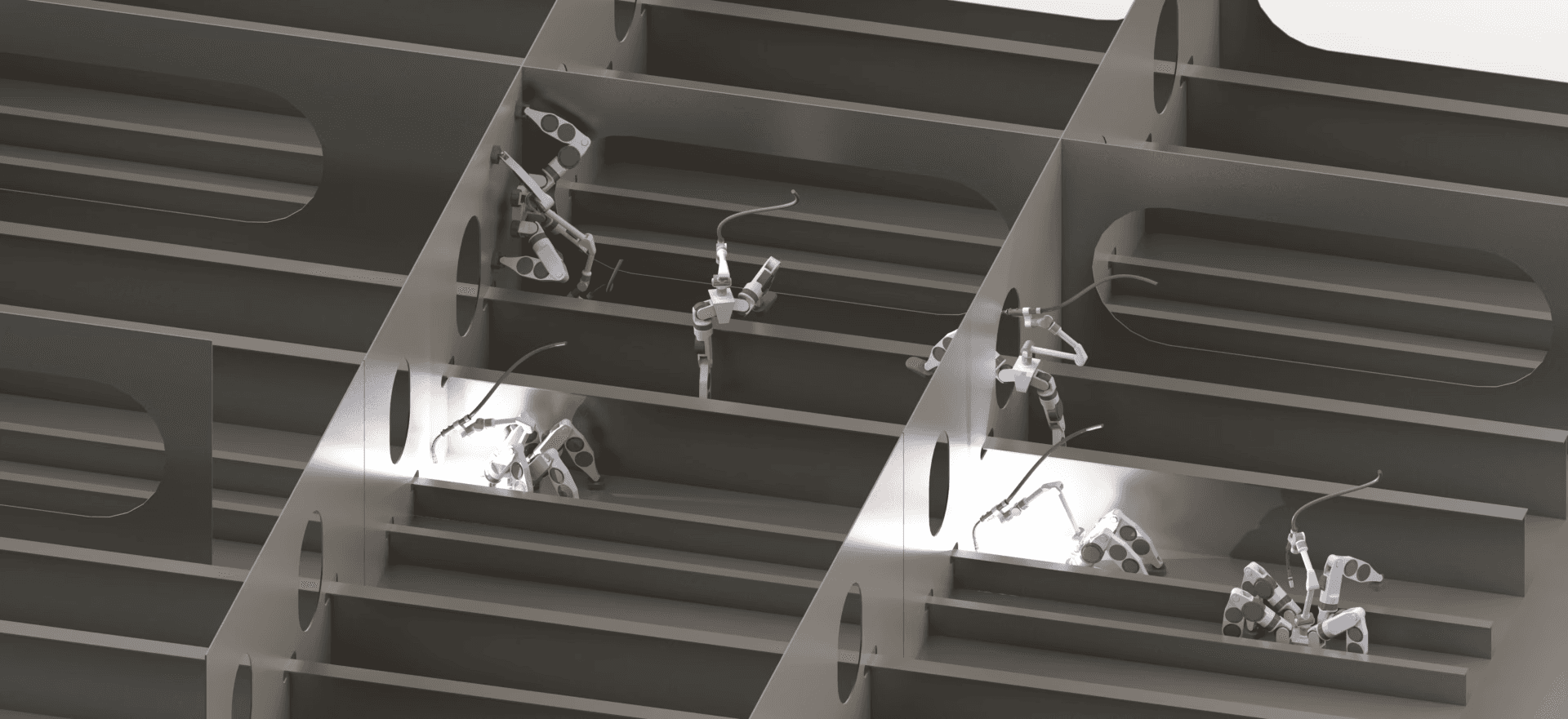
A concept rendering of a quadrupedal and a bipedal robot working together in an industrial environment of repeating bulkheads, stiffeners, and access holes.
Verified Numbers and Open Questions
For one actuator module to carry several bodies, the performance of a single actuator has to back it up. DIDEN Robotics' in-house actuator delivers a peak torque of 387 Nm from a unit weighing under 2 kg, reaching a maximum peak torque density of 194 Nm·kg⁻¹. Torque density, the amount of torque produced per unit of mass, is one of the metrics that matters for an industrial robot actuator carrying heavy equipment while moving and working.
That said, raising the gear ratio increases torque but lowers angular velocity, a trade-off that makes it hard to judge superiority on this metric alone. Even so, measured against a metric that matters especially for robots built to carry heavy loads, DIDEN Robotics' actuator sits at the top of the range in charts comparing it with commercial actuators worldwide.
This performance is confirmed under real load as well. DIDEN Robotics' humanoid lifted a 30 kg box, and the quadrupedal robot towed an additional 40 kg while carrying a collaborative robot (cobot) weighing over 10 kg on its back. The actuator has also advanced one generation from the initial model, becoming about 6% smaller while raising torque density by about 14%. Producing more force in a smaller volume means the quadrupedal robot carries the same payload on lighter legs, and the bipedal platform can shoulder heavy equipment on legs narrow enough to fit the passages people walk through.
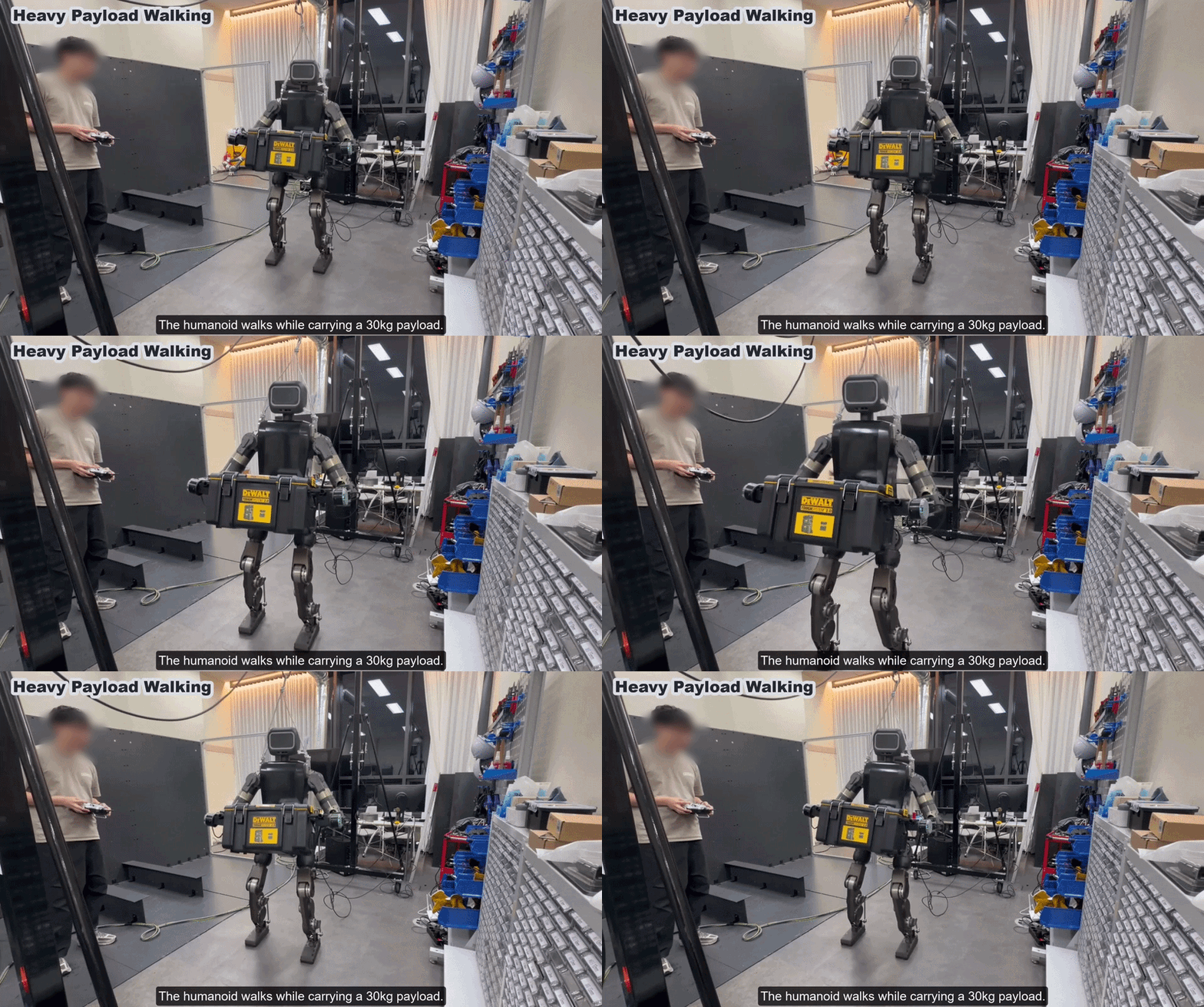
The humanoid walks while carrying 30 kg of equipment. Lifting a load and walking with it on your back place different demands on the actuator.

A quadrupedal robot with a cobot on its back tows a heavy load during testing. The test confirms how much force the same actuator module delivers under real load.
This performance and learning are already being applied on the quadrupedal robot at a major shipbuilder in Korea, one of the world's leading shipbuilding nations. It is not a demonstration: the robot moves and works in a real industrial environment. The open questions are clear too. Even with measurements folded into simulation, a residual gap remains, and narrowing it is a continuing task. And just as torque density carries a trade-off with angular velocity, the backlash a planetary gear allows has to be handled separately in areas that require precision work. DIDEN Robotics is carrying these points into the design of its next generation.
From One Stack to Every Body
The reason DIDEN Robotics has tied the actuator and the learning into a single problem is clear. A robot used every day on an industrial floor is, in the end, decided down in that invisible foundation. The actuator sits at the deepest layer of the robot, and a user has no reason to be aware it is there. But when that one component fails to hold, the locomotion control, self-localization, and environmental perception stacked above it waver along with it.
Measuring an actuator's properties may not, in itself, look like anything special. What sets DIDEN Robotics apart is that it does not measure and match the properties learning needs after the fact; it builds the actuator to have those properties from the design stage. Measurement is only the last step that confirms the design was right.
DIDEN Robotics is widening from one drive stack and one learning pipeline into the quadruped, the biped, and the humanoid. Being able to add a new robot form quickly also means being able to automate a new industrial task that much sooner. When hardware and learning evolve inside one loop rather than advancing separately, the range of work a robot can take over from a person on an industrial site widens with them. That is why DIDEN Robotics, the Physical AI company built for industrial environments, designs its actuators and its learning together.
DIDEN Spider
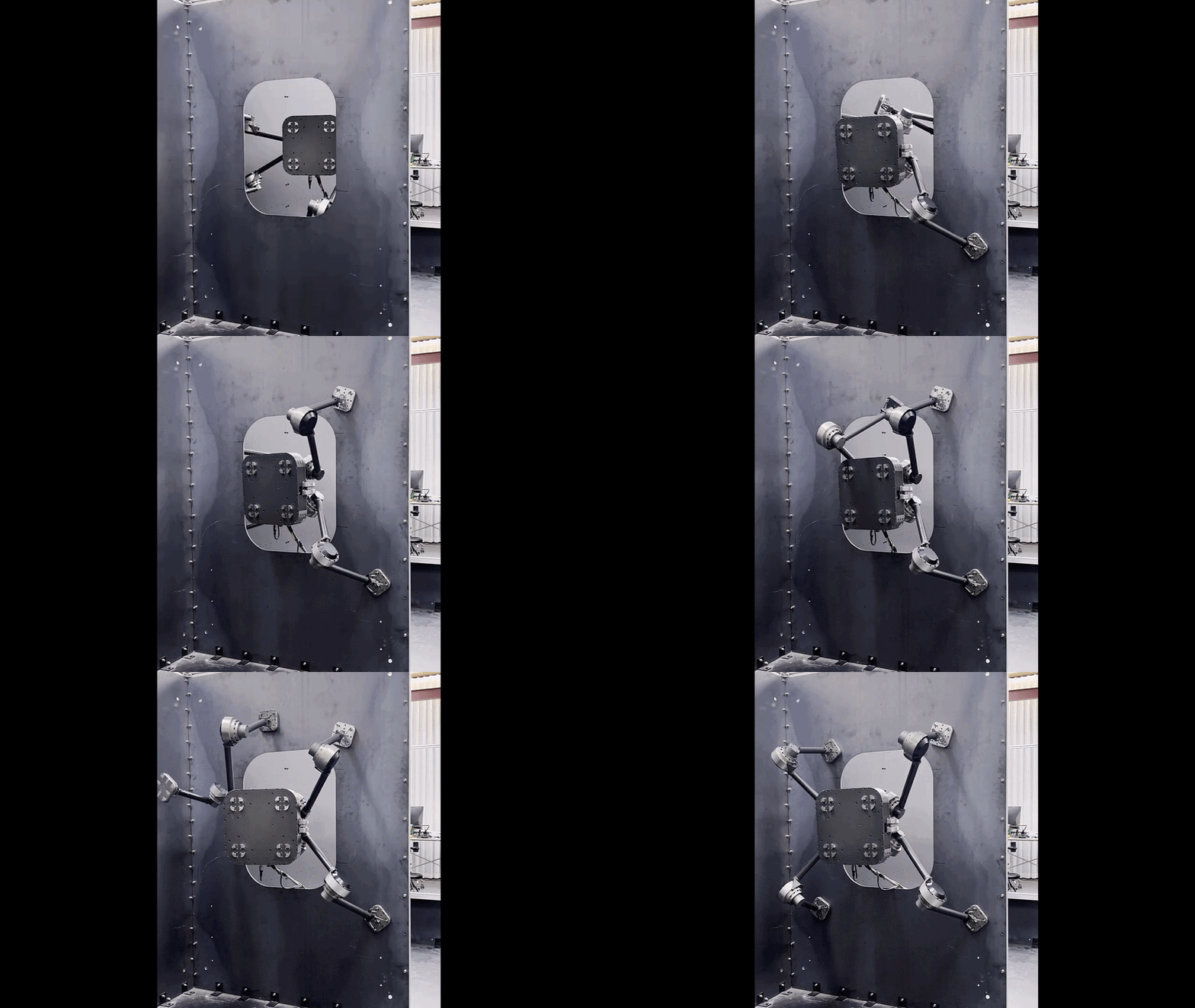
A quadrupedal robot Spider with magnetic feet passes through an access hole in a steel bulkhead. The same actuator module supports a body that climbs steel surfaces while carrying heavy equipment.
DIDEN Walker
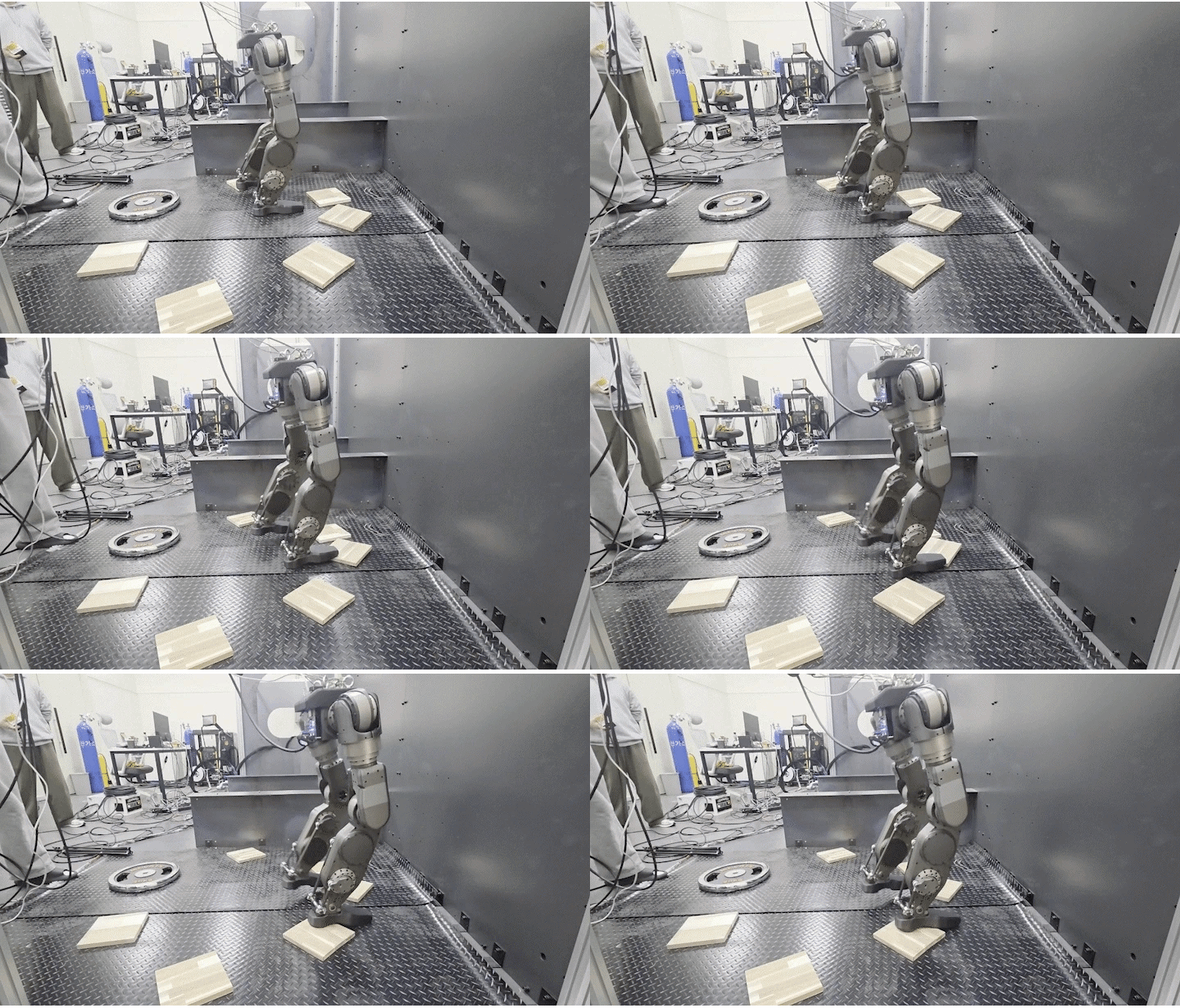
The bipedal platform Walker works with a manipulator on a steel structure, reaching confined spaces and working positions originally built for people.
DIDEN Humanoid
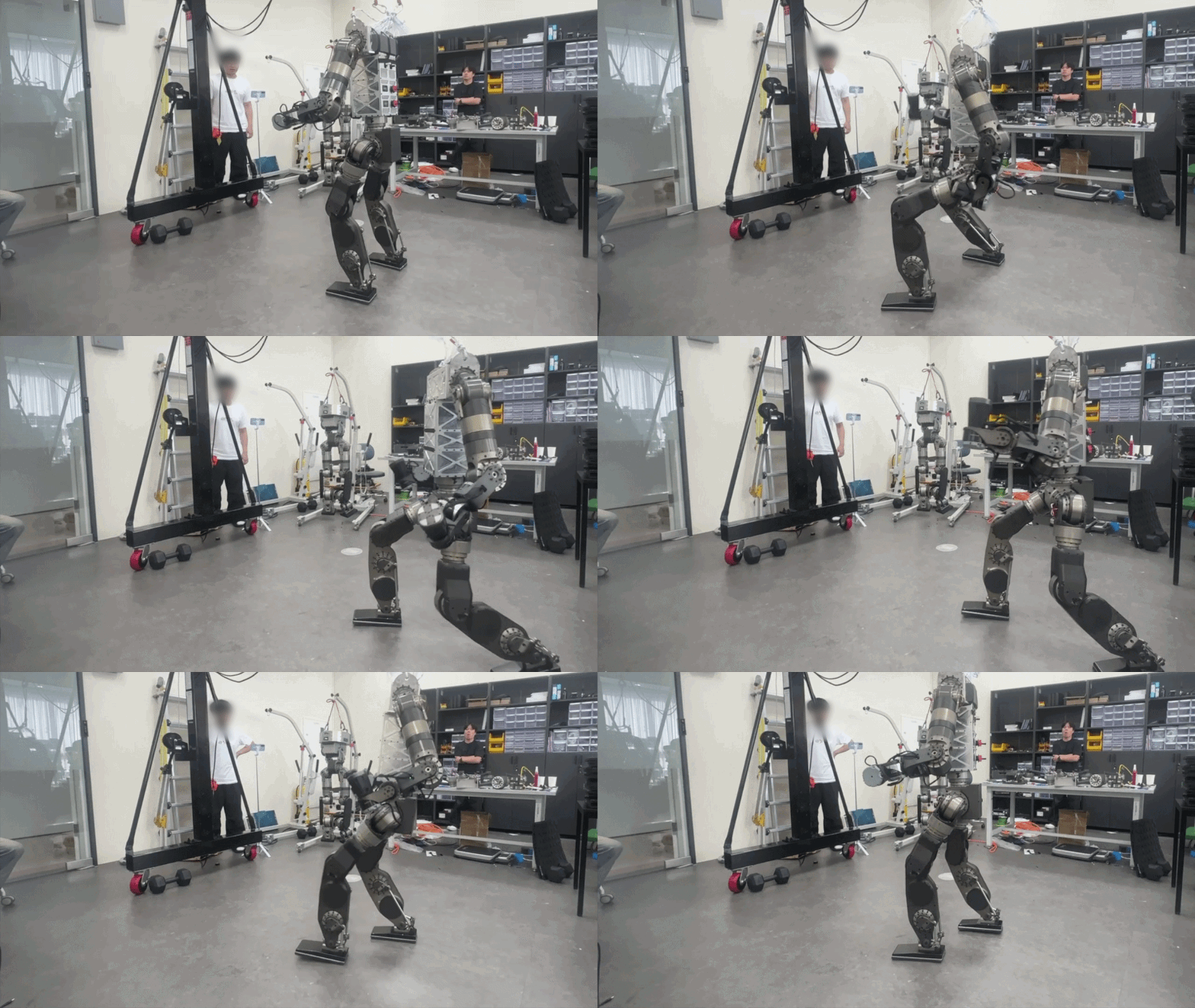
The humanoid walking on two legs. The actuator module and learning pipeline validated on the quadruped carry over into a human-shaped body.
South Korea
©Copyright DIDEN Robotics. All Right Reserved
Terms of Service
|
Privacy Policy
|
Legal Notice
|
Prohibition of Unauthorized Email Collection
Diden Robotics Co., Ltd.
|
Representative: Junny(Joon-Ha) Kim
|
Contact: diden@didenrobotics.com / Phone: 02-6959-0642 / Fax: 02-6959-0643
|
49 Achasan-ro 17-gil, Seongdong-gu, Seoul, Rooms 401, 402, 409, 410 (04799)
|
Business Registration Number: 867-87-03056
DIDEN ROBOTICS