How a Robot Makes Moves No Human Has Ever Shown It
On an industrial site, a robot’s motion has to exist before any learning can begin. In DIDEN Robotics’ model-based control, MPC looks ahead through the dynamics and finds the forces that keep the body stable inside its constraints, while RRT draws, in advance, where each foot should go.

Why Does Motion Have to Exist Before Learning?
For a robot that has to move on a real industrial site, the motion has to be built first, before learning ever starts—because no human has ever demonstrated that motion. Picture a quadruped robot walking across a steel structure on magnetic feet where a person could barely fit, threading a narrow passage inside a shipyard block, or stepping over an obstacle the height of an adult’s thigh. None of these are moves a person could have shown the robot first.
Robot motion is, admittedly, a field where the word “learning” comes to mind first. But learning is only possible once there is a motion to follow. Model-based control is what builds that motion in advance, and DIDEN Robotics’ robots move on a structure that layers learning on top of this model-based control.
DIDEN Robotics is a Physical AI company built for the industrial floor, and model-based control is one of the core technologies behind it. This article unpacks model-based control along two axes: MPC (Model Predictive Control), which defines the environment’s constraints in mathematical terms, and RRT (Rapidly-exploring Random Tree), which plans in advance where the next foot should land.
Three Environmental Constraints of a Magnetic-Foot Robot
For a magnetic-foot quadruped to move reliably on a steel structure on an industrial site, three conditions have to be satisfied.
The limit of magnetic adhesion — the force a magnetic foot can hold has a ceiling. The instant a force beyond that ceiling arrives, the foot lets go.
The limit of friction — friction has a range as well. Step outside it and the foot slips.
The dependency of the supporting legs — when three legs are magnetically attached and the body’s position and posture are fixed, the joint values of all three legs are computed automatically through inverse kinematics (IK). Only the remaining leg—the swing leg—is free to move.
These three conditions have to hold at every instant for a magnetic-foot robot to move across a steel structure. Beyond the shipyard—the first environment DIDEN Robotics validated—the same constraints apply in the same way across a range of industrial domains built from steel structures that people can barely enter.
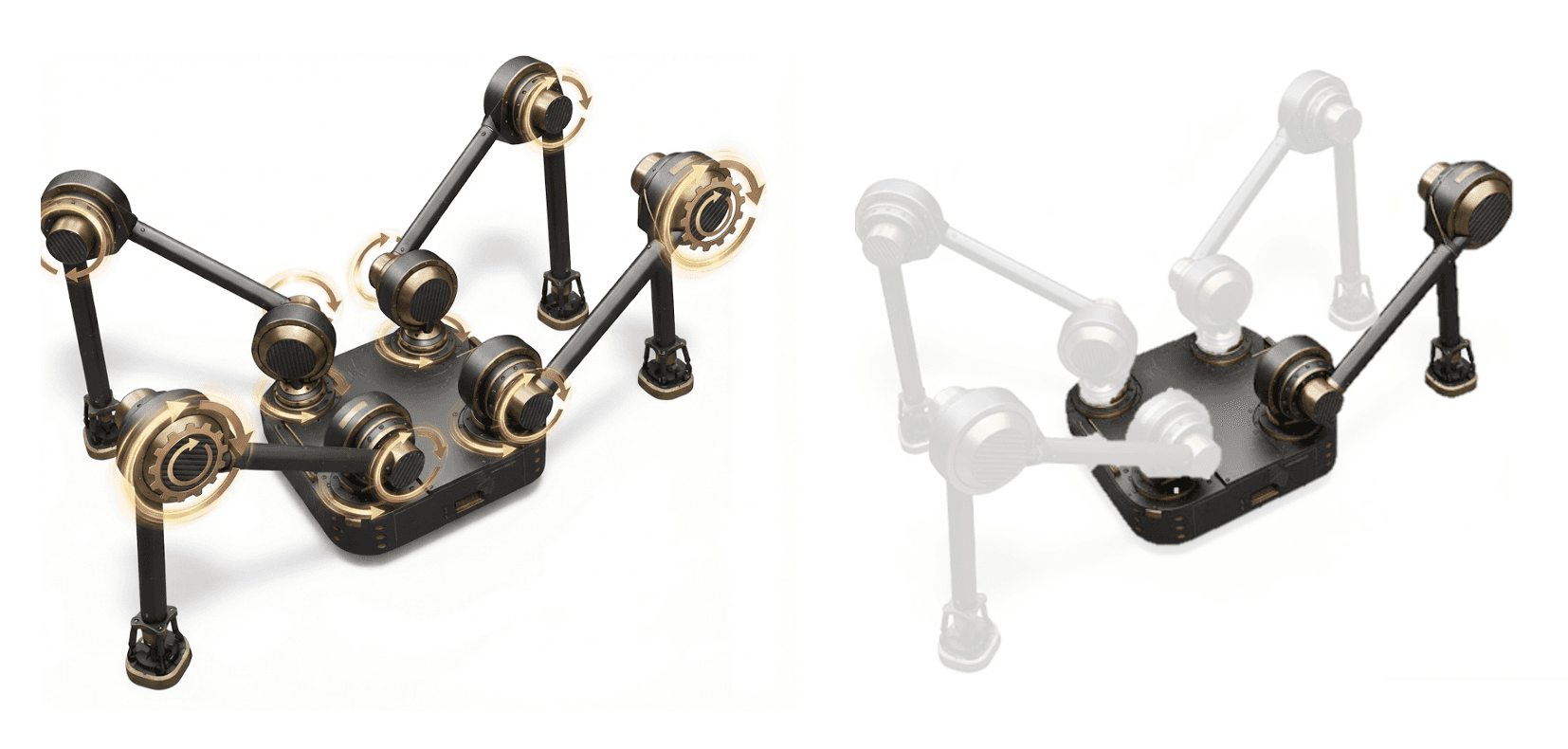
The body of a magnetic-foot quadruped and its four magnetic feet. The limit of adhesion, the limit of friction, and the dependency of the supporting legs all have to be satisfied together, at every instant, for the robot to move on a steel structure.
MPC — Bounding Motion With Mathematics
MPC, one of the two core axes of model-based control, is the module that bounds the environment’s constraints in mathematics. It encodes the three constraints above as mathematical conditions inside a model, predicts future motion using a simplified physics model, and selects only the motions that do not violate those conditions.
At the heart of this approach is the idea of a “feasible region.” The limits of magnetic adhesion, friction, and tilt together define a safe region of forces, and that region is computed in advance. At every instant, MPC solves for motion only within that region. Because the environment’s constraints are folded into the motion plan ahead of time, the robot can move reliably even in settings no human has ever demonstrated.
MPC is responsible for the forces acting on the body—at each instant, deciding the force the body will take within the feasible region is MPC’s role. But quadruped locomotion is not completed by MPC alone. The “control” that carries the swing leg (the lifted leg) to its target position, and the “magnet switching” that manages the moments a foot attaches and releases, have to be bound together with MPC into a single flow before the robot can move reliably on a steel wall.
RRT — Drawing the Posture That Threads a Narrow Passage
RRT, the second axis of model-based control, is the module that draws, in advance, the entire flow of posture: at what angle the body tilts, and in what order each leg is lifted, to pass through a narrow opening. In a complex environment—narrow passages, obstacles taller than a person, and structures that run from a wall onto a ceiling, all mixed together, as on an industrial floor—the bigger problem is not each individual motion but how to draw the whole path.
RRT grows a tree by scattering points at random. Starting from an initial posture, it samples points randomly through the space, and from the nearest existing node it extends the tree one step toward each point. If that step hits an obstacle it is discarded; if it does not, it is added to the tree as a new branch. Because there is no need to fill the entire space with a grid, RRT finds paths efficiently even for a magnetic-foot quadruped with high degrees of freedom.
RRT has a clear limitation, though. In an environment where a feasible passing posture is extremely rare—such as a narrow passage—random sampling has to wait until it happens to hit that narrow region by chance. A simple motion is solved in under a second, but a narrow passage can take tens of minutes. Worse for real-time operation, the same input can take a different amount of time on every run, so there is no way to predict when the robot will begin its next motion.
To resolve these two limitations of speed and unpredictability, DIDEN Robotics extended conventional RRT in two stages.
Stage 1: Experience-Based Reuse
Once a narrow-passage path has been solved, it is stored in a library; when a similar passage appears later, that path is pulled back out, transformed to fit the current starting posture, and reused. The first solution is hard, but in an environment where the same structure repeats—like a shipyard—that experience keeps accumulating and being reused. As a result, path planning that once took close to 40 minutes in a narrow passage dropped to under one second.
Stage 2: Collision Recovery
When a stored path is brought into a new environment, differences in fine structure can leave some segments colliding with obstacles. Two methods run in parallel and compete to restore those colliding segments. One is QP (quadratic programming) optimization, which pushes a colliding posture out of the obstacle while staying inside the mathematical constraints. The other is a local RRT that re-plans only the narrow colliding segment. The two run simultaneously, and whichever finishes first is adopted. This goes beyond simply raising the average speed. Where QP gets stuck, the local RRT catches it, and where the local RRT is slow, QP finishes first—each covering the other’s weak cases.
MPC and RRT Combined, Proven on the Industrial Floor
The combination of MPC and RRT has already been proven on a real industrial site. The first environment DIDEN Robotics validated with a quadruped robot was a shipyard—a setting where passing through a narrow opening and working inside that opening have to be solved at the same time.
Validation proceeded in stages.
Unloaded passage in simulation — passing through a narrow opening in a virtual environment with no payload.
Loaded passage with a commercial manipulator — passage completed under a loaded state close to real working conditions.
Passage through a tighter specification — the most recently confirmed stage; passage completed even in an environment with more demanding dimensions.
Over the course of these stages, RRT was strengthened in step. A “post-processing” pass that pulls the path itself smooth, like an elastic band; a “bidirectional search” that grows the path from both ends at once to sharply cut search time; an “experience-based search” that reuses paths solved in the past; and a “reinforcement technique” that salvages even paths with slight collisions—each was added in turn. The result: less time to find a motion, and a firmer path quality.
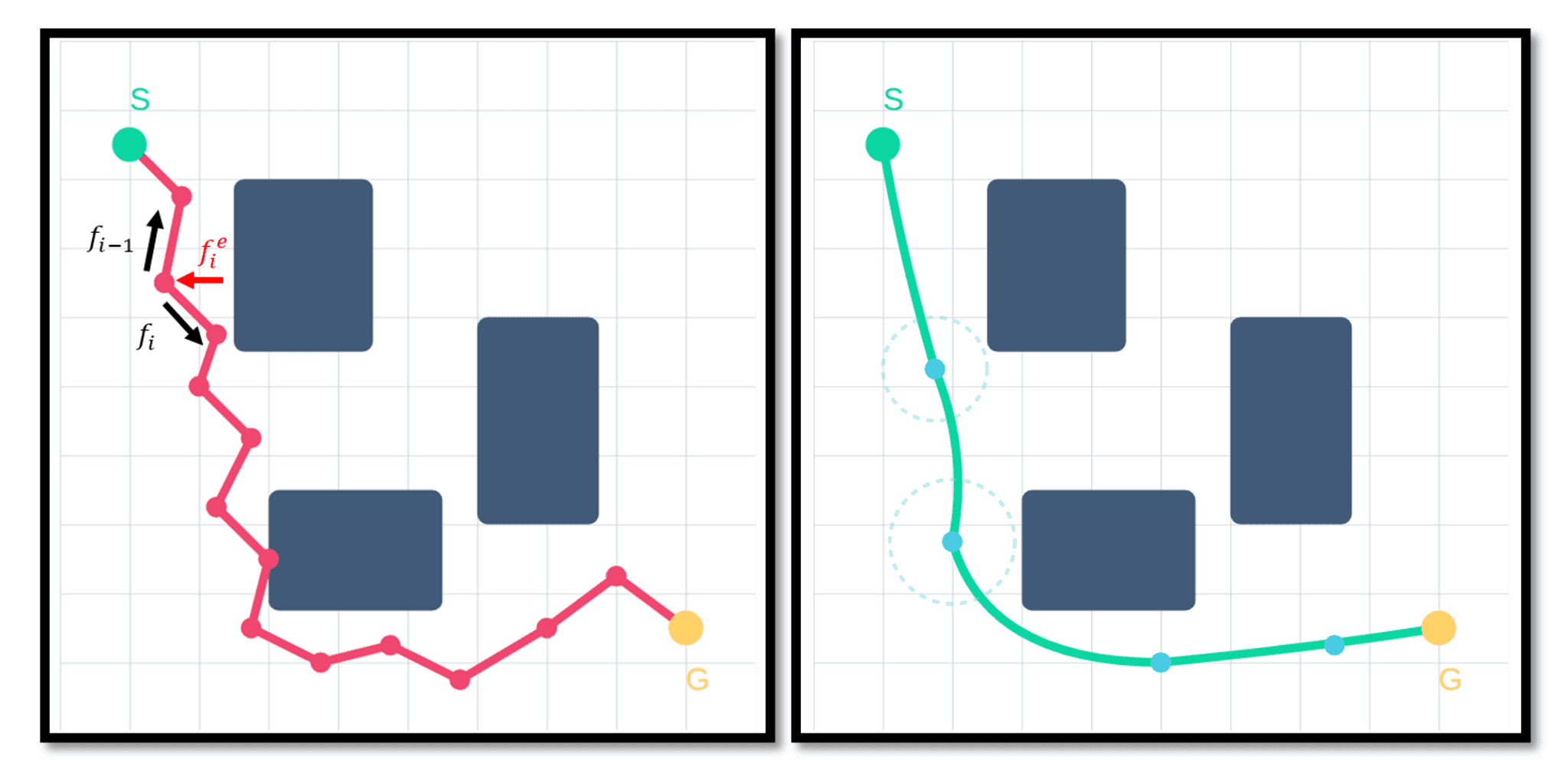
RRT raw path (left) and the path after refinement (right). Even with the same start (S) and goal (G), pulling the path itself smooth—like an elastic band—produces a shorter, cleaner route.
With a manipulator loaded onto the robot, collision-avoidance computation becomes considerably more complex. DIDEN Robotics’ in-house acceleration algorithm cuts that computation time, and with it the entire work cycle. Continuous movement between blocks became possible, too. Once placed, a robot can now travel and work across a wider area, which reduces how often it has to be repositioned and raises the continuity of the work.
Expanding in Two Directions at Once — Learning and Process Autonomy
DIDEN Robotics’ model-based control framework is expanding in two directions at once.
The first is to layer on learning and to widen the range of industries it serves. Once model-based control produces a motion, reinforcement learning imitates and practices that motion (motion-tracking reinforcement learning), and in the next step it searches for more efficient motions on its own (off-policy reinforcement learning). This two-stage structure—first build the motion, then layer learning on top—has already been validated on a quadruped robot, and the process was covered in detail in the previous Locomotion article. The same approach is underway at the simulation stage on a bipedal platform. Meanwhile, the same magnetic feet and the same control stack are expanding into other industrial sites, building on the foundation validated in the shipyard.
The second direction is an expansion into a hierarchical control structure. Model-based control handles the lowest-level control, the shortest unit, in DIDEN Robotics’ control stack. As tasks and scenarios stack on top of it, the path leads to process autonomy on the industrial floor.
As a Physical AI company built for the industrial floor, DIDEN Robotics starts by drawing—in mathematics—the path that learning will follow, and then layers learning and autonomy on top of it.
South Korea
©Copyright DIDEN Robotics. All Right Reserved
Terms of Service
|
Privacy Policy
|
Legal Notice
|
Prohibition of Unauthorized Email Collection
Diden Robotics Co., Ltd.
|
Representative: Junny(Joon-Ha) Kim
|
Contact: diden@didenrobotics.com / Phone: 02-6959-0642 / Fax: 02-6959-0643
|
49 Achasan-ro 17-gil, Seongdong-gu, Seoul, Rooms 401, 402, 409, 410 (04799)
|
Business Registration Number: 867-87-03056
DIDEN ROBOTICS