Building Robots That Succeed 100 Times Out of 100: An Interview with Diden Robotics COO Youngha Shin
Diden Robotics COO Youngha Shin on why Diden Spider took a spider-like form, building actuators in-house, and why field robots must succeed 100 out of 100.

Blog
"In the lab, a robot that succeeds five times out of ten is enough to show potential. But a robot that works in the field has to succeed 99, even 100 times out of 100."
That is why Youngha Shin, COO of Diden Robotics and leader of its hardware, kept returning to reliability throughout our interview. Changing the form of Diden Spider and deciding to build its actuators in-house both came down to one goal: a robot that works the same way, every time, in the field.
Youngha Shin is a co-founder of Diden Robotics and head of its hardware division. Shin earned a Ph.D. in mechanical engineering at KAIST and designed hardware for legged robots at HUBO Lab*, in Professor Hae-Won Park's** lab. HOUND, a quadruped robot Shin designed during those lab years, set a Guinness World Record for the 100-meter sprint.
* HUBO Lab: Grew out of the lab of KAIST Professor Jun-Ho Oh, whose team built HUBO, Korea's first bipedal robot, in 2004. The lab won the 2015 DARPA Robotics Challenge in the United States.
** Professor Hae-Won Park: Professor of Mechanical Engineering at KAIST and director of the Humanoid Robot Research Center. He received a U.S. National Science Foundation (NSF) CAREER Award (2018), and his research on MARVEL, a legged robot with magnetic feet, was featured on the cover of Science Robotics (2022). He currently serves as CSO of Diden Robotics.
We talked with Shin about how Diden Spider evolved from a dog-like form into a spider-like one, why a team that set out to buy actuators ended up building its own, and what the team only learned once it went out into the field. Finally, we asked what kind of engineers Diden Robotics' hardware team wants to work with.
Designing Robots, and Designing a Company
Q. Tell us about your role at Diden Robotics.
I'm a co-founder, the COO, and head of hardware. In the lab, I worked on both hardware development and control for legged robots. Mechanical design was my strongest area, so I took on the initial design of Diden Spider. Today, our team members have taken over that design and keep developing it further.
As head of hardware, I mainly look at the technical direction of our mechanical and electrical teams, and at how the two teams communicate with each other.
These days, I spend more of my time on COO work. If I had to sum up the COO's job in one line, it's everything that helps the whole organization achieve the most with the least time spent. That includes things like how we run meetings and how often, and onboarding new team members.
Q. How did you get into robotics?
To be honest, I didn't start out with a big ambition for robots. I was good at math, so I went to a science high school, and my physics grades were good, so I went on to study mechanical engineering at KAIST.
Around graduation, I decided to go to graduate school, but I couldn't choose a field right away. So I worked backwards, crossing off the fields that didn't suit me one by one, and robotics was what remained. Robotics is also the field where results are easiest to see, so it felt like a good fit.
That's how I joined HUBO Lab. Looking back, I first found the joy of building things with my own hands as an undergraduate, when I handled hardware in a club that built cars. And the more I worked on robots, the more I liked them. I tend to find something to enjoy in whatever environment I'm in, and the environment I happened to be given was robotics.
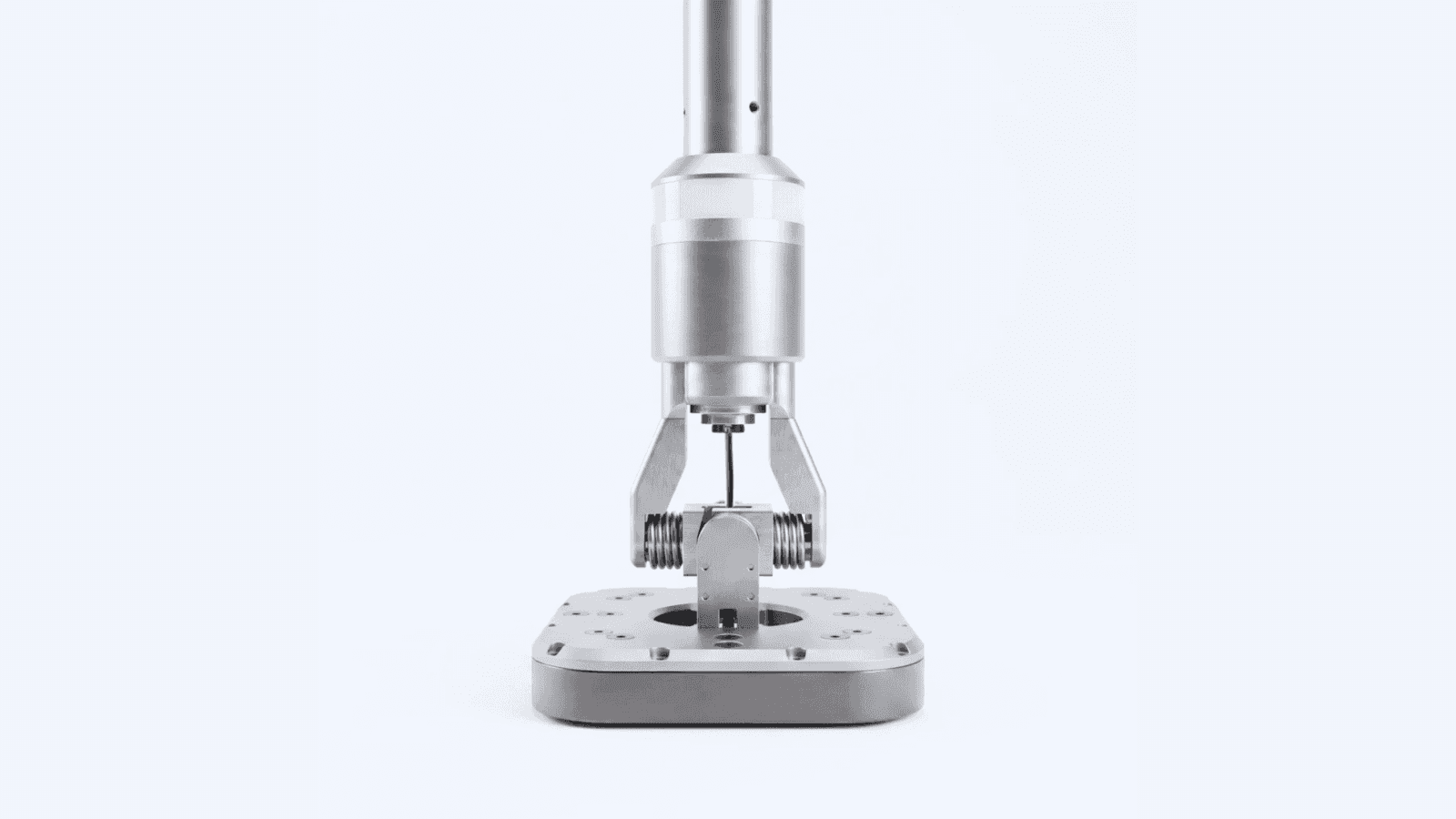
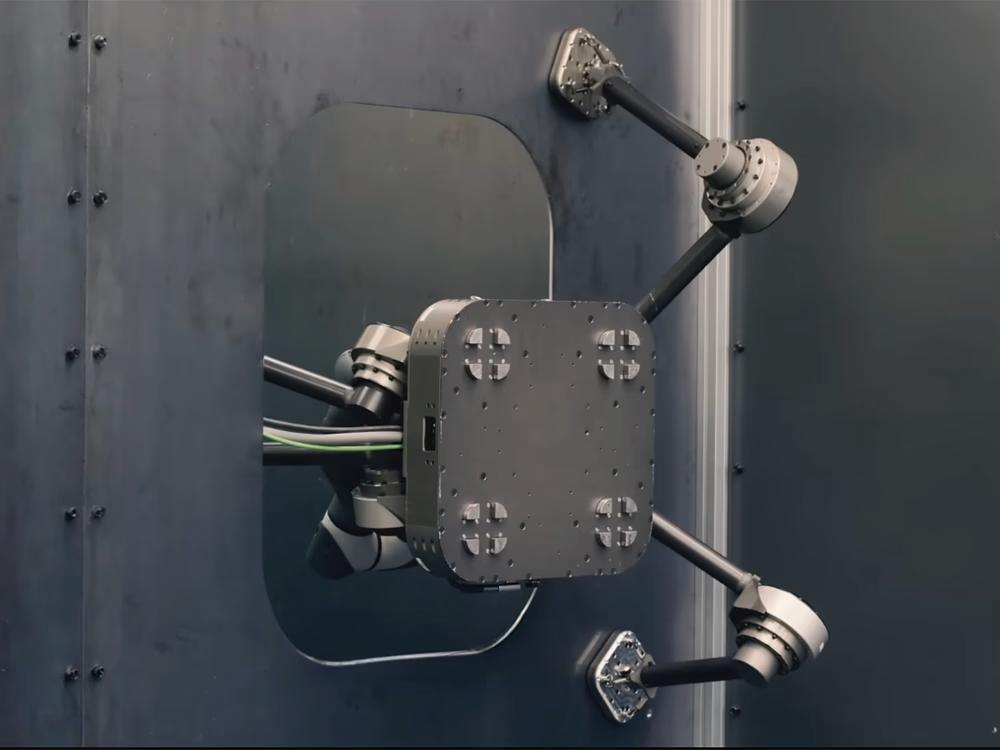
▲ Diden Spider’s magnetic foot, which can switch its magnetic force on and off instantly. Source: Diden Robotics website
From Dog to Spider: How the Quadruped Evolved
Q. As a co-founder, what was on your mind when Diden Robotics started?
I had always wanted to start a company. Many people around me had done it, so the idea never felt unfamiliar.
In the second half of 2022, Yong Um*, a colleague in the same lab, published a paper on magnetic feet, and we started thinking together about what we could do with the technology. We considered other product ideas at first, but we already had a good robot in the lab, so there was no reason to do something else. I had designed a quadruped robot called HOUND** in the lab, so we decided to put magnetic feet on HOUND and build a robot that climbs steel walls.
* Yong Um: One of the four co-founders of Diden Robotics. Currently leads the company's New Technology Research Team.
** HOUND: A quadruped robot that Youngha Shin designed in Professor Hae-Won Park's lab and presented as first author at ICRA 2022. In July 2026, research using HOUND was featured on the cover of Science Robotics.
With that concept, we entered E*5 KAIST*, KAIST's student startup program. After about three months of preparation, we were selected as an Excellence Team (2nd place). Investors started reaching out, and after some market research, we concluded it was worth pursuing for real.
* E*5 KAIST: KAIST's flagship student startup support program, run by the KAIST Startup Institute since 2012.
Q. How was the original concept different from today's Diden Spider?
As I mentioned, the original concept was to put magnetic feet on HOUND. In the early days, we ran many experiments with MARVEL*, a small quadruped robot Yong Um was researching in a KAIST lab, and it also had a dog-like form.
* MARVEL: A wall-climbing quadruped robot from Professor Hae-Won Park's lab, with Yong Um as co-first author. It climbs vertical steel walls at 70 cm per second and can walk upside down on ceilings. The research was featured on the cover of the December 2022 issue of Science Robotics.
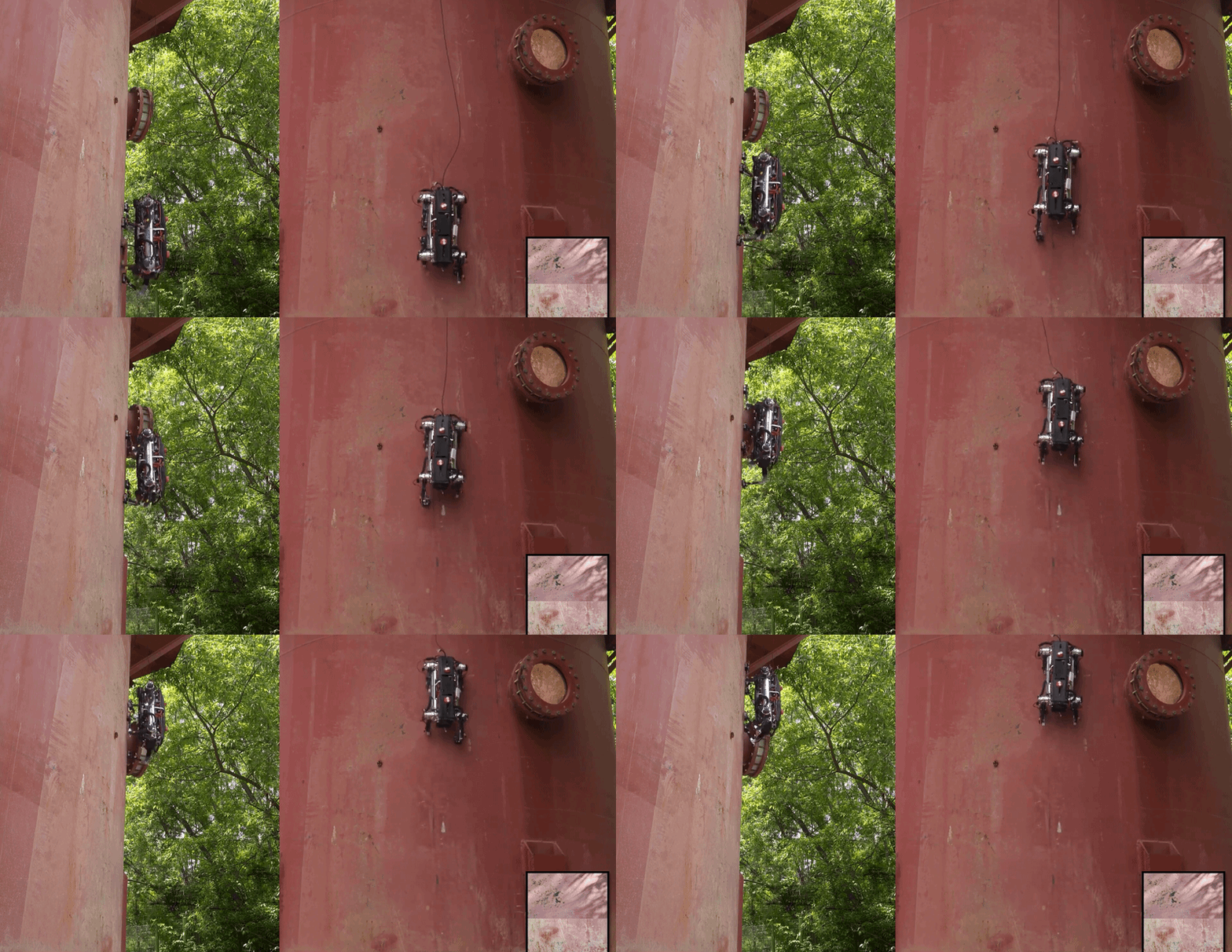
▲ MARVEL climbing a steel column. Source: KAIST DRCD Lab YouTube
But our experiments showed that the dog-like form ran into trouble when turning on a wall. A quadruped robot has twelve joint actuators. When it climbs straight up a wall, perpendicular to the ground, eight of them support the body. Once the body turns sideways, only four do. On top of that, if the soles of the feet didn't sit flat against the wall, the robot sometimes flipped over.
In a spider-like form, the body sits on the inside with the legs extending outward, so the body stays close to the wall and the feet meet it almost parallel to its surface. Based on those experiments, and after studying research projects that had tried spider-like designs, we concluded this form was far better suited to climbing walls. Compared with the original concept, only the form changed. The core idea, a quadruped that climbs walls with magnetic feet, stayed the same.

▲ A dog-like form (left) and a spider-like form (right) on a wall. The top row compares the actuators that support the body when it turns sideways, and the bottom row compares the angle at which the feet meet the wall. Source: Diden Robotics
Size was also a problem. For a wall-climbing robot to do real work in the field, it has to carry the equipment for that work on its back. How much it can carry effectively sets the range of jobs it can do. MARVEL weighs less than 10 kg, so it can carry only about 3 kg. That was only enough to mount a small camera for surveillance or reconnaissance.
Then we learned there was demand for robots in shipyard welding, and our research showed that efforts to bring robot arms into the field had already begun. The problem was that a welding robot arm weighs over 10 kg. Carrying that much weight on its back required a much larger robot. That's why we chose HOUND, not MARVEL, as our starting point.
Diden Spider's first form combined a HOUND-sized body with spider-like legs and magnetic feet. That basic form has carried through, almost unchanged, to this day.
Why We Decided to Build Our Own Actuators
Q. Even after settling the form and size, there must have been many challenges. How have you worked through them?
I think we're a team that can solve a problem as long as we know what it is. Most problems go unsolved because people don't know what the problem actually is. That's how we got from a dog-like form to today's spider-like one. We pinpointed that the number of actuators supporting the body drops to four when it turns on a wall, and that the robot flips over if its soles don't sit flat against the wall. Knowing that, we could solve both by changing the form.
Requests from the field work the same way. The robot needs to walk with its magnetic feet switched on so it doesn't fall even when its body leans to one side. But the people using the robot in the field wanted to see for themselves whether each foot was properly attached.
After hearing that, we added LEDs to the feet so they could see right away whether each magnetic foot had attached. That's how we've solved problems: once we hear what customers need and understand exactly what the problem is, we build the fix into the design.
Q. Many robot makers buy their components. Was building your own actuators always the plan?
Ironically, when we first designed Diden Spider, I was the first to argue strongly against building our own actuators. That was even though I had designed plenty of actuators in the lab.
My thinking was: if you're opening a restaurant, you don't need to start by growing your own rice. Just buy the rice. The robot market had matured enough that many companies sold actuators, and buying them looked like the better choice on cost as well.
So we actually bought and tried actuators from two or three overseas suppliers. Then, while the robot was walking, a shoulder actuator got pulled right out while the foot stayed planted on the ground. The joints couldn't hold firm either; they wobbled without strength. We decided we'd be far better off building our own, and from then on, we made our actuators in-house. Since then, we've rarely had problems like that. I think most robotics engineers with hardware experience can relate to this story.
▲ Left: an early unit built with purchased overseas actuators collapsing mid-walk. Right: today’s Diden Spider, with in-house actuators, walking on a steel wall. Source: Diden Robotics
Q. Actuators are often described as the muscles that move a robot's joints. What makes your in-house actuators different?
An actuator's real-world performance depends on getting everything right: how precisely the tolerances are set, how the parts are joined, and which materials are used and how they're treated. Not all of this makes it onto the drawings, and you can't learn it just by taking an actuator apart. We built up this experience by breaking a lot of hardware, going back to our lab days.
Take Diden Spider. It has to carry 30 kg on its back and hold itself up even in the worst case, with only three feet attached. When we ran the numbers, a motor of around 1 kg alone didn't have enough force. So we added a gearbox to increase it. Because the magnetic feet attaching and detaching send frequent, strong impacts through the joints, we chose a planetary gear design: it handles shock well, and its simple structure makes maintenance easy.
Within that, we focused on actuators that deliver high force. Depending on the application, some actuators prioritize fast rotation and others prioritize efficiency. What matters for our robots is carrying heavy loads and moving steadily, even if a little more slowly, to get the work done.
One of the key metrics that shows this in numbers is peak instantaneous torque density: the maximum rotational force an actuator can deliver momentarily per kilogram of its own weight. Our actuator reaches 194 N·m/kg, among the highest in the world.
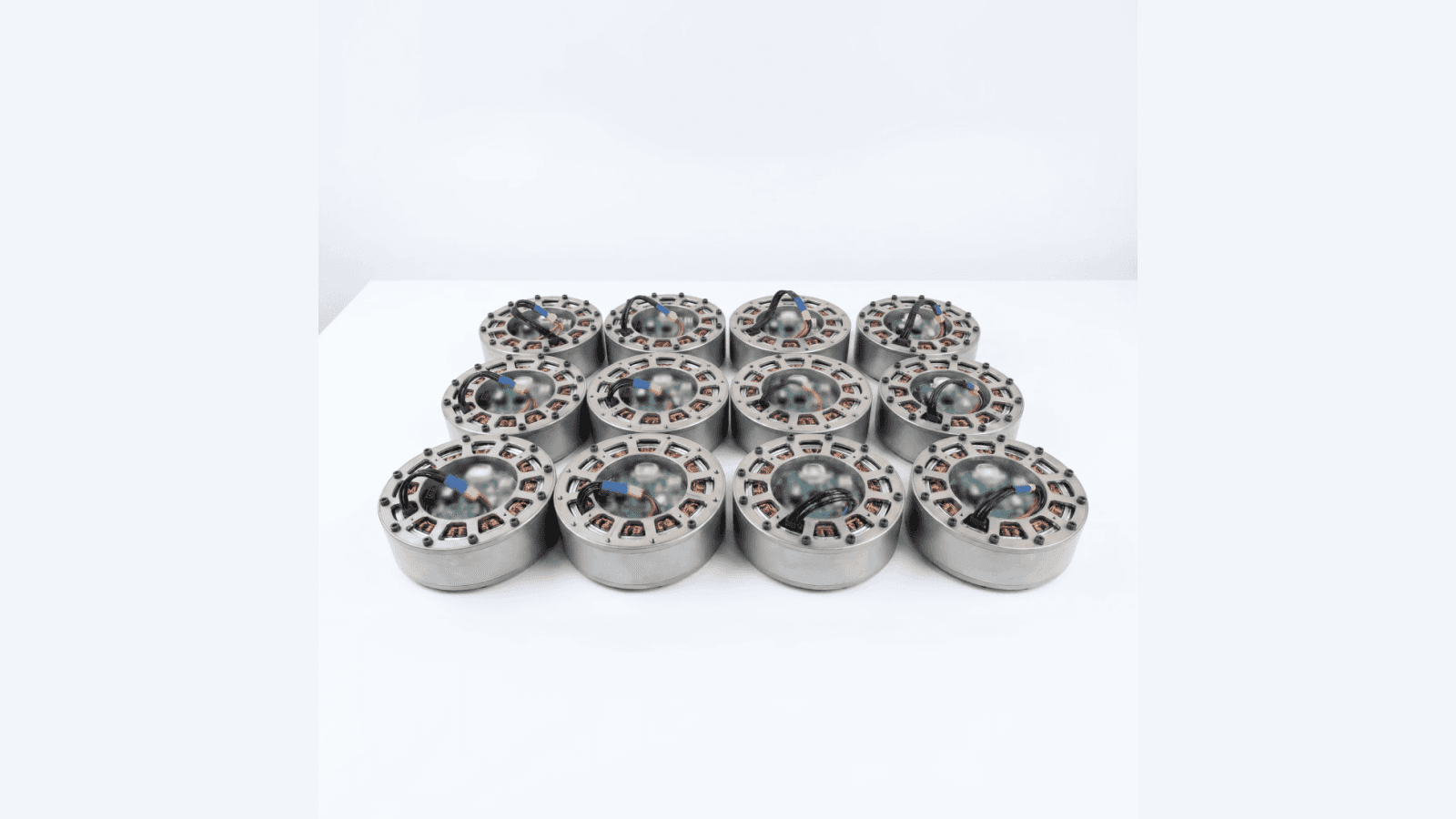
▲ An actuator designed and built in-house by Diden Robotics. Source: Diden Robotics website
Not Five Out of Ten, but 100 Out of 100
Q. What is the difference between a robot in the lab and a robot working in the field?
The biggest difference I feel is reliability. In the lab, it's fine if you film ten takes and five of them fail. The goal is to show what's possible.
But for real use in industrial settings, a robot has to succeed 99, even 100 times out of 100 attempts. It can't work three times and then fail on the fourth. How stably a robot repeats the same motion over long hours of operation: that's reliability, and it's a word I think about a lot these days.
There's also a lot you can only learn by going to the field. Our in-house test block was made of steel plates laid side by side with their edges touching, without welding or fastening them together. In a real shipyard, though, the plates are welded together, which leaves bumpy ridges called weld beads along every seam. Robots in the field would catch on these weld beads and lose their balance. So we're going a step beyond our existing control methods and applying AI-based locomotion control that uses reinforcement learning.
Sometimes the field was actually easier. The steel plates in our lab were as smooth as a mirror and reflected light straight back, so the vision sensors had trouble recognizing the surface. Plates in the field, on the other hand, have a rougher, anti-corrosion-treated surface, which made recognition easier. Environments really do differ that much.
80% of the Job Is Assembly and Disassembly
Q. What kind of engineers work in hardware? What do you look for when hiring?
The main things I look for are hustle and clear communication. In hardware especially, you have to be good at the hard, hands-on work. It's something I've emphasized since my lab days.
People new to hardware often imagine that most of the job is the cool part: designing robots, drawing up plans, and rendering them in 3D. But as I've always said since the lab, 80% of the actual work is assembling, disassembling, and repairing. Time at the desk is about 20%, or even less.

▲ Inspecting an early model of Diden Spider. Source: Diden Robotics
Some people might wonder whether they really have to do this work themselves. But no one else can do it for you. The difference between someone who assembles with an understanding of the structure and someone who doesn't shows up clearly in something as small as a loosened bolt.
When I meet a candidate for the first time, I look at how much they've built. With some people's personal projects, the result alone shows how much they assembled and struggled through. We've mostly brought on people like that, and our electrical team uses the same standard.
Q. How do the hardware and software teams work together?
In the lab, the boundaries were blurry. I did both design and control work myself. At the company, responsibilities are fairly clearly divided. There's so much to do to build a single robot that no one person can handle it all.
With the software team, we mostly decide together which component specifications to use. The size of the compute unit that goes inside the robot depends on which algorithms we plan to run. A larger unit gives more computing power but is harder to fit inside the robot, while a smaller unit means the software side has to optimize its algorithms more. Sometimes we get requests like shortening the legs a little because they collide with each other during control.
When we're asked to add more compute because there's a lot to process, the hardware side first works out what's possible, taking heat, space, and maintenance into account. Then the software side adapts as much as it can. That doesn't mean we decide unilaterally. We keep adjusting together, along the lines of, 'That approach is hard, so how about this instead?'
One of our strengths is that we talk a lot. At some places, decisions are made at the top and that's the end of it, but we keep asking about and understanding each other's needs. Seen positively, that means smooth communication and consideration for one another. Seen another way, decisions might look a little slower. Still, we choose to talk a lot and keep aligning hardware and software.

▲ Electrical circuits and boards designed in-house. Source: Diden Robotics website
Q. What advice would you give engineers interested in Diden Robotics?
Not long ago, I talked with a junior team member who was thinking about their career path. I told them that to grow, your environment matters most, especially whether there are skilled people around you.
That was true for me, too. In the lab, I quickly picked up the design knowledge my seniors had built up, but some of it didn't hold. The tolerance for the bore that holds a bearing was a typical example. Following what I'd been taught, I made the bore just slightly larger than the bearing. Every time the robot moved, the bearing shifted minutely inside the bore, and the robot kept rattling.
Then I learned a completely different approach from another senior who had done research overseas: make the bore just slightly smaller than the bearing and press-fit it tightly. It seemed backwards at first, but once I made the change, the rattling went away. When I studied further, I found that was the standard. That's when I realized how much your growth depends on who's around you.
Technology is advancing quickly, so I think learning continuously from great people matters more than anything. Diden Robotics brings together people who have been through it all in labs that have led robotics research in Korea, so growth, at least, was never something I worried about.
I also think the time you spend experiencing firsthand the field differences you can't learn in a lab is truly valuable. Stabilizing a robot takes a lot of hands-on hardware work, and that's an area AI still struggles to take over. Diden Robotics puts robots into real field sites, so there's a great deal to learn from that experience.
From Spider to Humanoid: Technology That Carries Over
Q. The robotics industry is paying special attention to humanoids these days. How is Diden Robotics approaching them?
I think what ultimately divides robot forms is whether the priority is mobility or manipulation. A quadruped is like a four-legged desk: push it, and it doesn't easily tip over. It's strong at moving stably. A humanoid shares the human form, so it can use things designed for people, like chairs, handles, and drills, as they are.
We built up mobility first. We asked where the market was for robots whose value comes largely from moving themselves to the spot where the work happens, and shipyard welding was exactly that kind of place.
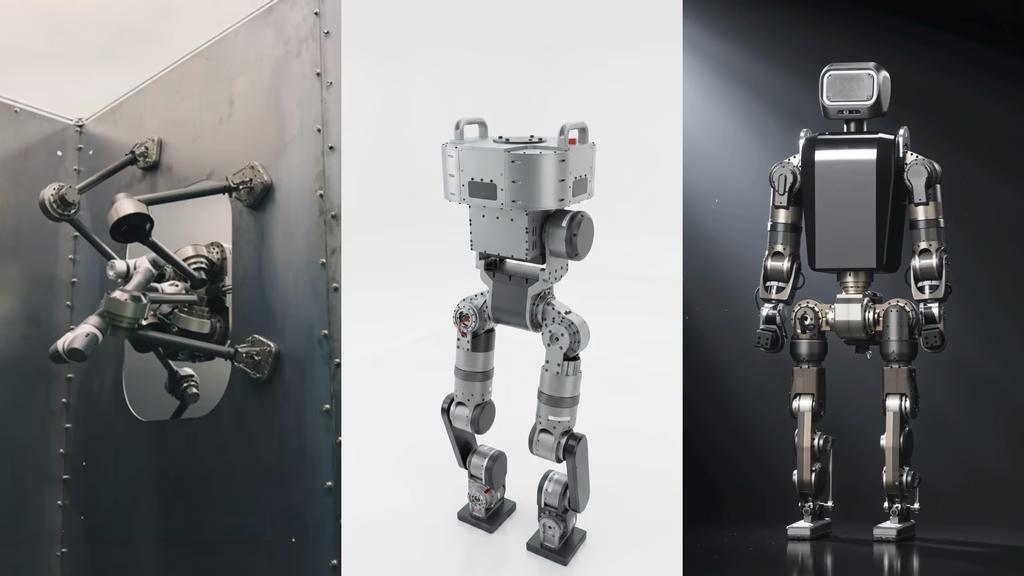
Diden Walker and Diden Humanoid are being developed from the same starting point. Both were designed with mobility in industrial settings in mind first. Diden Spider has a low center of gravity and a wide stance on four feet, so it can move heavy equipment far more stably. Diden Walker has a form similar to a person's, so it can get through access holes, the waist-high openings that connect ship blocks, much faster. Diden Humanoid's strength is climbing up and down structures built for people, like ladders and stairs.
The same standard applies to manipulation. For robots in the field, durability matters as much as precision. They shouldn't break easily when bumped. And plenty of tasks can be done well with a gripper that has just the degrees of freedom the job needs, without the dexterity of a human hand.
The technology we built through Diden Spider carries over even as the form changes. Our magnetic feet, which let a robot walk while attached to steel, are a common foundation that also goes into Diden Walker. Actuators are the same. The legs, which have to withstand heavy loads and frequent impacts, use the same actuators for the same reasons, and for Diden Humanoid, we are developing every actuator in-house except those in the hands. We apply the same reliability standard that keeps robots running in the field for the long haul.
Making Robots as Trusted as a Phone
Q. What keeps you doing this work, even when things get busy?
Above all, I enjoy being able to keep doing the work I've been doing.
When I look at seniors who went to large corporations, many end up doing something different from what they did before. One who only wrote code ended up in design, for example. They accept it as, 'A Ph.D. is someone who knows how to open and close projects, so you can't expect to keep doing only what you did before.' What I value most is being able to keep going deeper into the work I've been doing.
When I think about building robots and bringing them into the field, I think of amusement park rides and mobile phones from when I was a kid. As a child, I believed nothing could ever go wrong on a ride, so I wasn't scared at all. I thought phones were perfect products without any bugs, too.
But as I grew up, I realized that rides and phones were products designed and built by people like me. The robots I build today are made by human hands, too. I believe robots can also become something people use as naturally as rides or phones. We're still on that path, but I work with the goal of building a product people in the field can trust without a second thought.
The work that started with Diden Spider now continues with Diden Walker and Diden Humanoid. If the day comes when people working in the field keep our robots by their side and use them as naturally as a phone, that will be the greatest reward of this work.

▲ From left: Diden Spider, Diden Walker, and Diden Humanoid. Source: Diden Robotics website
Everything Youngha Shin shared comes back to a single standard: if you know exactly what the problem is, you can solve it, and a robot working in the field has to succeed 100 times out of 100. Diden Spider's shift from a dog-like to a spider-like form, the actuators the team set out to buy but ended up building, and the weld bead problem and magnetic foot LEDs that came out of the field all grew from that standard.
Diden Robotics' hardware team wants to work with engineers who have built a lot themselves, who don't shy away from the hands-on work of assembly and disassembly, and who keep talking with colleagues to find answers. If you want to help build robots the field can trust, check the open positions on the Diden Robotics careers page.
More from Diden Robotics

The Five Branches of Diden Robotics' Control Electronics: Circuit Design Started with In-House Actuators and Magnetic Feet
Blog

Robot Perception in Harsh Industrial Environments: Three Sensor Swaps and What Finally Decided It
Blog
Why a Quadruped, a Biped, and a Humanoid All Walk the Same Way: Co-Designing Actuators and Learning
Blog
How a Robot Makes Moves No Human Has Ever Shown It
Blog